Introduction
Something is changing inside companies that most investors are not tracking closely enough.
Not at the product level. Not at the revenue level.
At the cost structure level.
AI agents are moving from experimental pilots into production workflows across major enterprises. And the financial impact is becoming measurable.
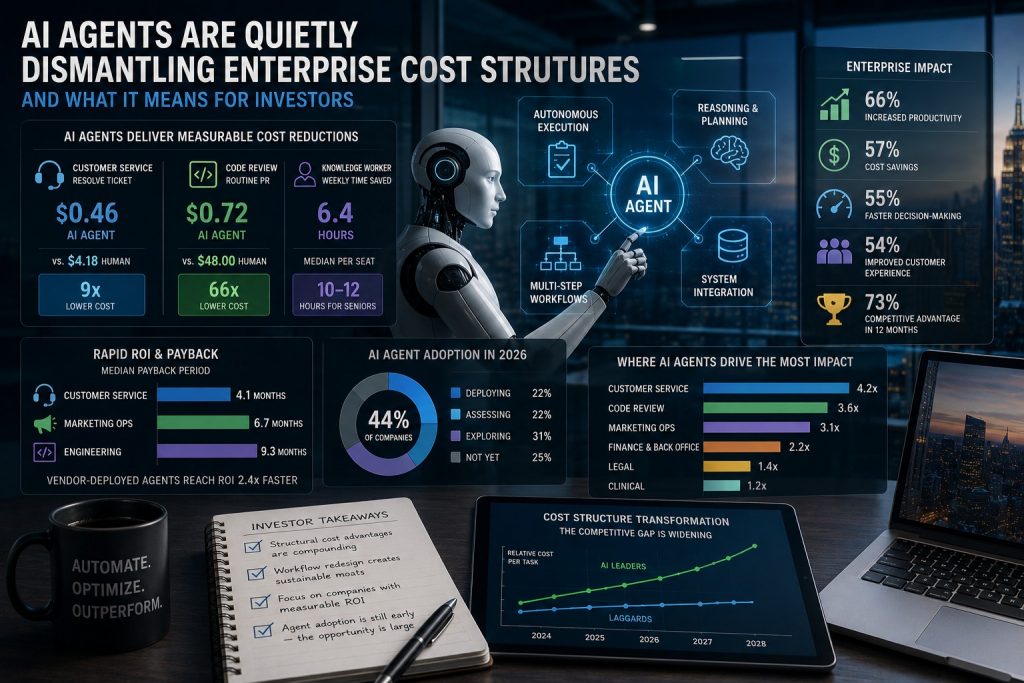
Knowledge workers using AI agents are recovering hours of productivity every week. Customer service workflows, software development tasks, and operational processes are becoming dramatically cheaper.
This is no longer theoretical.
It is happening now.
What AI Agents Actually Are
AI agents are different from traditional generative AI tools.
A chatbot responds to prompts. An AI agent receives a goal, breaks it into tasks, executes actions across systems, evaluates results, and completes workflows with limited human intervention.
That distinction matters.
The shift from AI assistance to AI execution changes enterprise economics completely.
Why 2026 Is Different
The major transition in 2026 is deployment at scale.
Companies are moving beyond experimentation and integrating AI agents directly into production environments.
Organizations are reporting measurable improvements in productivity, cost savings, and operational speed.
The focus is no longer “Can AI work?”
The focus is now “How fast can AI reduce costs?”
The Cost Structure Transformation
The financial impact is becoming visible across multiple functions.
Customer service workflows are being automated at dramatically lower costs than human handling.
Software engineering teams are reducing routine development and review expenses.
Back-office operations, financial reporting, and administrative tasks are increasingly automated.
This reduces operational expenses while increasing scalability.
The Productivity Divergence
AI adoption is creating a growing productivity gap inside companies.
Employees effectively using AI agents are significantly outperforming non-adopters.
Organizations that redesign workflows around AI are gaining structural advantages.
Companies using AI superficially are falling behind.
Where the Biggest Changes Are Happening
Customer service is one of the most mature deployment areas.
AI systems now handle large percentages of enterprise support requests automatically.
Software development is another major transformation area.
Routine coding and review tasks are increasingly automated, lowering development costs.
Supply chain and operations are also changing rapidly.
AI-driven simulations, forecasting, and workflow automation are improving efficiency while reducing waste and capital expenditures.
The Competitive Advantage AI Agents Create
The most important advantage is not short-term savings.
It is the compounding effect over time.
Companies deploying AI agents generate operational data that improves future AI performance.
Workflow redesign knowledge becomes an internal asset.
Cost advantages eventually become pricing advantages.
Investment Implications
AI agent deployment changes enterprise valuation assumptions.
Labor costs as a percentage of revenue may decline structurally for leading adopters.
Revenue-per-employee metrics are improving.
Capital efficiency is increasing for AI-native businesses.
The gap between AI leaders and laggards is widening.
The Risks Investors Should Watch
Not every AI deployment succeeds.
Some organizations are adopting AI superficially without redesigning workflows.
Others struggle with governance, integration, and organizational resistance.
The difference between successful and failed deployments is increasingly operational execution rather than model capability itself.
Conclusion
AI agents are reshaping enterprise cost structures in real time.
The companies successfully redesigning workflows around AI are building durable competitive advantages.
Their margins improve. Their operational efficiency increases. Their scalability expands.
For investors, the challenge is identifying which companies are achieving genuine transformation versus performative AI adoption.
The enterprise cost structure is changing.
And the companies changing it fastest may become the dominant winners of the next phase of the AI investment cycle.
This article is for informational purposes only and does not constitute financial or investment advice. Always consult a qualified financial professional before making investment decisions.