Introduction
The most valuable companies in the AI era are not publicly traded.
Not yet.
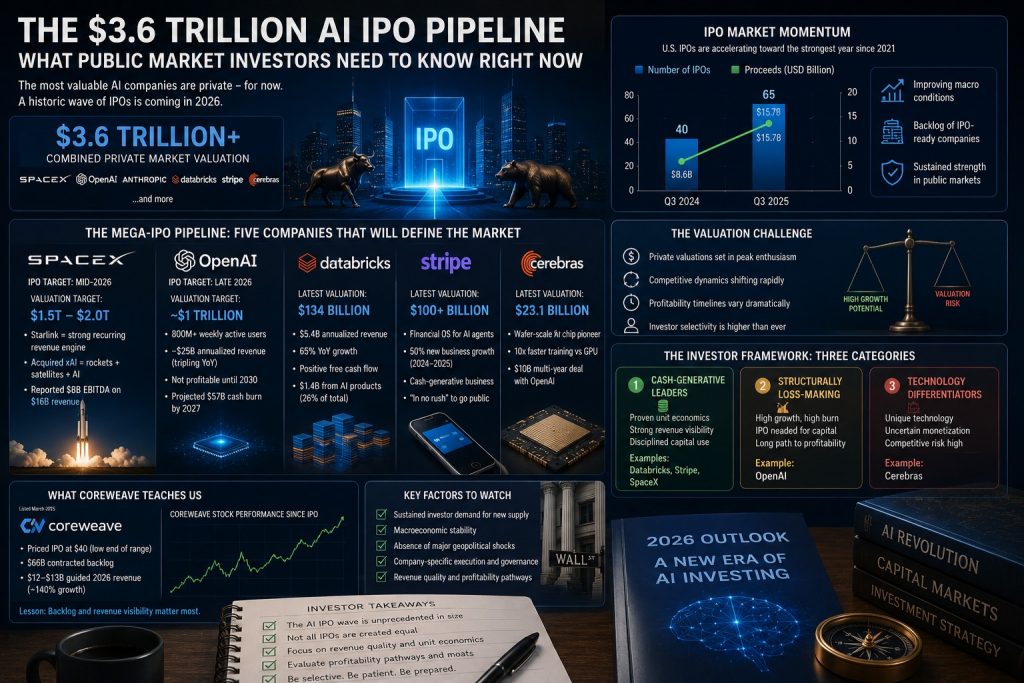
SpaceX, OpenAI, Anthropic, Databricks, Stripe, and Cerebras together represent private market valuations exceeding $3.6 trillion.
And many of them are moving toward public markets.
For investors, 2026 may become the most important AI IPO cycle in history.
The AI IPO Wave Is Accelerating
The IPO market has reopened.
After years of weak listings and delayed offerings, momentum is returning as market conditions improve.
Major AI companies are preparing for potential public listings, creating unprecedented investor interest.
This is not a normal technology cycle.
It represents the transition of foundational AI infrastructure companies from private ownership into public markets.
The Companies Leading the Pipeline
Several companies are positioned at the center of this wave.
SpaceX has evolved beyond aerospace into a combined infrastructure and AI platform through Starlink and xAI integration.
OpenAI has become one of the fastest-growing technology companies ever created, with massive user adoption and rapidly expanding revenue.
Databricks stands out for its strong financial discipline and growing AI-related enterprise business.
Stripe continues expanding as the financial infrastructure layer for internet and AI-driven transactions.
Cerebras is positioning itself as a specialized AI hardware alternative focused on high-performance training workloads.
The Valuation Challenge
Private market valuations create unique risks.
These companies achieved massive valuations during the strongest AI investment enthusiasm in history.
Public market investors may apply different standards.
Growth expectations, profitability timelines, and competitive pressures will heavily influence how these IPOs perform after listing.
Different Types of AI IPO Candidates
Not all AI companies entering public markets should be evaluated the same way.
Some companies already generate strong cash flow and sustainable revenue.
Others remain highly dependent on external capital and long-term growth assumptions.
Technology differentiation also matters.
Strong technology alone does not guarantee durable market leadership.
What Investors Can Learn From Recent AI IPOs
Recent AI-related listings provide important signals.
Public markets reward revenue visibility, operational discipline, and scalable business models.
Investors increasingly focus on profitability pathways instead of pure growth narratives.
This changes how future AI IPOs may be priced.
The Market Absorption Question
The scale of the AI IPO pipeline is enormous.
Public markets must absorb hundreds of billions of dollars in potential offerings.
This creates challenges.
Investor demand, interest rates, macroeconomic stability, and market sentiment will all influence how smoothly these IPOs are received.
The Global Dimension
The AI IPO story is not limited to the United States.
Asia and Europe are also building major technology and AI ecosystems.
International exchanges are competing aggressively to attract AI listings and growth companies.
This broadens the global AI investment landscape significantly.
The Framework Investors Should Use
Several factors matter most when evaluating AI IPOs.
Revenue quality.
Profitability pathways.
Competitive positioning.
Capital efficiency.
And operational discipline.
Companies with sustainable economics and strong execution are more likely to succeed long term than those relying entirely on narrative momentum.
Conclusion
The AI IPO era is beginning.
For the first time, public market investors may gain direct access to companies building the infrastructure of the AI economy.
But this opportunity comes with significant complexity.
Valuations are large. Competition is intense. Expectations are extremely high.
The investors most likely to succeed will be those who evaluate these companies with discipline rather than excitement alone.
The AI IPO wave could define the next decade of technology investing.
This article is for informational purposes only and does not constitute financial or investment advice. Always consult a qualified financial professional before making investment decisions.