Introduction
For the past several years, the AI investment story has focused mainly on software.
Large language models, enterprise AI platforms, and digital automation systems have dominated investor attention.
But a second wave is emerging.
Physical AI.
AI systems that not only process information but also interact with the physical world through robots, autonomous systems, sensors, and machines.
This may become one of the largest investment opportunities of the next two decades.
What Physical AI Actually Means
Physical AI combines intelligence with real-world action.
Unlike traditional software AI systems, physical AI must perceive environments, adapt to uncertainty, and perform physical tasks reliably.
This includes robots in factories, autonomous vehicles, drones, warehouse systems, and industrial automation platforms.
The challenge is not only intelligence.
It is real-world execution.
Why Physical AI Is Different From Digital AI
Digital AI produces information.
Physical AI performs actions.
That difference changes the economics, complexity, and timeline of adoption.
A chatbot answering questions is fundamentally different from a robot navigating a warehouse or assembling products autonomously.
Physical environments are unpredictable.
This makes physical AI significantly more difficult — but also far more valuable if successful.
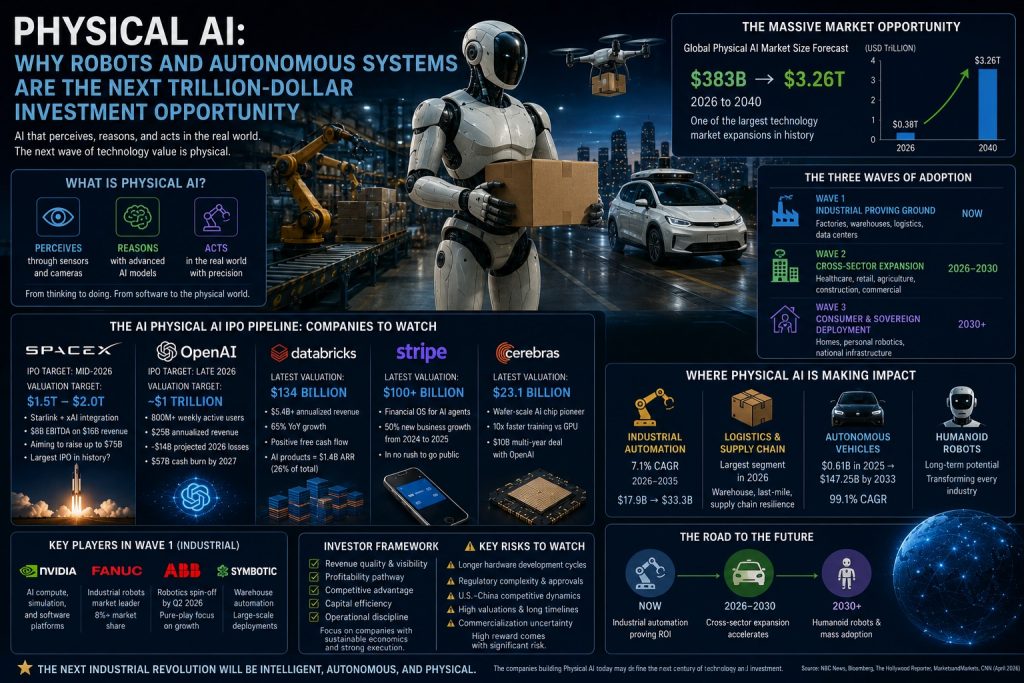
The Three Waves of Physical AI Adoption
Physical AI adoption is happening in stages.
The first wave focuses on structured industrial environments such as factories, warehouses, and logistics centers where automation delivers measurable ROI.
The second wave expands into healthcare, retail, agriculture, and commercial operations.
The third wave eventually reaches consumer and large-scale public deployment through humanoid robots and autonomous infrastructure.
Each wave builds on the previous one.
Industrial Automation Is Already Happening
Industrial robotics represents the most mature part of the physical AI market.
Labor shortages, rising manufacturing costs, and reshoring trends are accelerating automation investment globally.
Major industrial companies are integrating AI directly into robotics platforms and factory operations.
Factories are becoming increasingly autonomous.
Logistics and Warehouse Automation
Logistics is one of the fastest-growing physical AI sectors.
Autonomous warehouse systems improve speed, reduce labor dependency, and increase operational efficiency.
Large-scale deployments are already visible in fulfillment and distribution networks.
This is transforming supply chain economics.
Humanoid Robots: The Long-Term Opportunity
Humanoid robots attract the most attention.
These systems aim to operate in environments built for humans while performing flexible physical tasks.
Current deployments remain limited.
But rapid advances in robotics hardware, AI perception systems, and manufacturing efficiency are accelerating development.
This remains one of the most important long-term opportunities in physical AI.
Autonomous Vehicles and Mobility
Autonomous driving is one of the most commercially advanced forms of physical AI.
Robotaxi services, autonomous logistics, and self-driving systems are expanding rapidly.
Major technology and automotive companies are competing aggressively in this market.
The economics are compelling because labor represents the majority of transportation operating costs.
The Nvidia Infrastructure Layer
Nvidia plays a central role in physical AI.
Robotics systems require simulation environments, AI chips, and edge computing infrastructure.
Nvidia provides much of the foundational technology powering these systems.
For many investors, infrastructure providers may offer broader exposure than betting on individual robotics companies.
The Risks Investors Should Understand
Physical AI is a major opportunity, but risks remain significant.
Hardware development cycles are slower than software cycles.
Regulation is more complex.
Commercial deployment takes time.
Competition between the United States and China may also reshape market dynamics.
Many long-term projections assume technological progress that has not yet fully materialized.
Conclusion
Physical AI represents the next major stage of the AI economy.
Factories, warehouses, logistics systems, autonomous vehicles, and humanoid robotics are gradually becoming intelligent and autonomous.
The transition will not happen overnight.
But the companies building the infrastructure, hardware, and deployment ecosystems today may define the next generation of global technology leaders.
Physical AI is no longer a distant concept.
The first wave is already happening.
This article is for informational purposes only and does not constitute financial or investment advice. Always consult a qualified financial professional before making investment decisions.