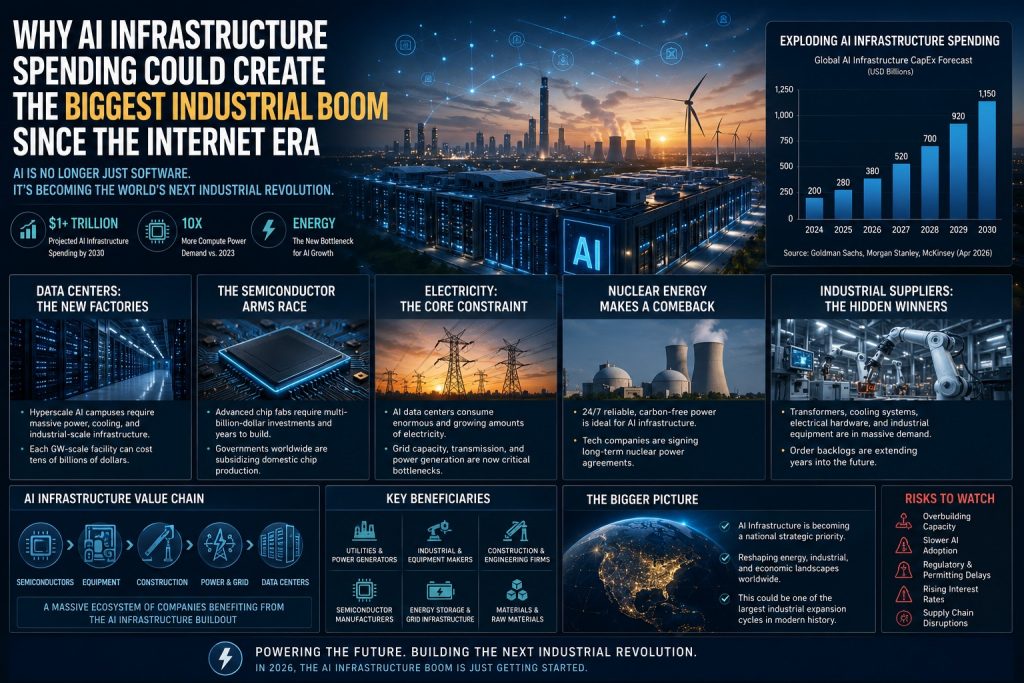
Why AI Infrastructure Spending Could Create the Biggest Industrial Boom Since the Internet Era
Last Updated: April 2026 | Category: AI Investment Trends
Introduction
Most investors still think the AI revolution is mainly about software.
Chatbots.
AI assistants.
Image generation tools.
Autonomous coding systems.
But beneath the surface, the largest economic impact of AI may actually come from something far less glamorous:
Infrastructure spending.
The AI boom is triggering one of the largest industrial expansion cycles in decades.
Data centers are being constructed at unprecedented speed. Utilities are expanding power generation capacity. Semiconductor manufacturers are racing to build fabrication plants. Governments are subsidizing domestic chip production. Cloud providers are spending hundreds of billions of dollars on physical infrastructure.
This is no longer just a technology trend.
It is an industrial transformation.
And the companies benefiting are increasingly spreading far beyond traditional software businesses.
The AI Buildout Is Becoming Physical
For years, technology investing focused heavily on digital products.
Software scaled rapidly without requiring massive physical expansion.
AI changes that dynamic completely.
Every major AI system requires:
- Massive server infrastructure
- Advanced cooling systems
- Electricity generation
- Semiconductor manufacturing
- High-speed networking
- Industrial construction
- Power transmission systems
Unlike previous internet platforms, AI cannot scale infinitely through software alone.
Physical infrastructure becomes the limiting factor.
That changes the investment landscape dramatically.
Why Data Centers Have Become the New Factories
Modern AI data centers are closer to industrial facilities than traditional office technology infrastructure.
A hyperscale AI campus may require:
- Hundreds of thousands of GPUs
- Dedicated substations
- Gigawatts of electricity
- Water cooling systems
- Backup energy infrastructure
- Specialized industrial equipment
Construction costs can reach tens of billions of dollars for a single AI-focused facility.
The largest technology companies are now effectively behaving like industrial conglomerates rather than software businesses.
Microsoft, Amazon, Alphabet, and Meta are investing capital at levels historically associated with oil companies, railroads, and manufacturing giants.
The AI economy increasingly resembles an industrial economy.
The Semiconductor Arms Race Is Accelerating
Semiconductors remain the foundation of the AI ecosystem.
But the challenge is no longer just chip design.
It is manufacturing capacity.
Building advanced semiconductor fabrication plants requires:
- Multi-billion-dollar investments
- Highly specialized labor
- Years of construction
- Advanced supply chain coordination
Governments worldwide are aggressively supporting domestic chip production because semiconductor dependence has become a geopolitical issue.
The CHIPS Act in the United States accelerated domestic investment in semiconductor manufacturing.
Similar policies are emerging globally.
This creates structural demand for:
- Industrial equipment manufacturers
- Materials suppliers
- Construction firms
- Automation companies
- Infrastructure providers
The AI boom is quietly reviving industrial sectors many investors ignored for years.
Electricity Is Becoming the Core Constraint
One of the most underestimated parts of the AI boom is energy demand.
AI data centers consume extraordinary amounts of electricity.
As AI workloads increase, electricity demand rises alongside them.
This creates pressure on:
- Power grids
- Utility companies
- Energy infrastructure
- Transmission systems
- Backup generation capacity
Some regions are already facing delays in AI data center expansion simply because sufficient electricity is unavailable.
That reality changes how investors think about utilities.
For years, utilities were considered slow-growth businesses.
AI infrastructure demand is beginning to transform them into growth sectors.
Why Nuclear Energy Is Returning to the Conversation
The AI economy requires stable baseload power.
Solar and wind remain important, but their intermittency creates challenges for AI infrastructure operating continuously.
That is why nuclear energy is regaining strategic importance.
Nuclear power offers:
- 24/7 generation
- Carbon-free electricity
- Large-scale output
- Grid reliability
Several technology companies are already pursuing direct partnerships with nuclear operators to secure future electricity supply.
This would have sounded improbable only a few years ago.
Now it is becoming increasingly normal.
Industrial Companies Are Quietly Benefiting
Many of the biggest AI beneficiaries are not household technology names.
They are industrial suppliers operating behind the scenes.
AI infrastructure expansion requires:
- Transformers
- Cooling systems
- Ventilation equipment
- Electrical hardware
- Construction engineering
- Grid equipment
- Specialized manufacturing
These businesses rarely dominate headlines.
But demand for their products is accelerating rapidly.
Some industrial companies are now experiencing order backlogs extending years into the future because AI infrastructure demand exceeds current production capacity.
The AI Boom Is Reshaping Labor Markets
AI infrastructure expansion also affects employment.
Construction workers.
Electrical engineers.
Industrial technicians.
Semiconductor specialists.
Energy infrastructure developers.
The AI economy is creating demand for physical-world labor in addition to software talent.
This is another reason the current AI cycle differs from previous technology waves.
The impact extends beyond Silicon Valley.
It spreads into manufacturing hubs, energy markets, industrial regions, and construction sectors across entire economies.
Why Governments Are Treating AI Like National Infrastructure
Governments increasingly view AI infrastructure as strategically important.
Countries are competing to secure:
- Semiconductor independence
- Energy reliability
- Domestic manufacturing
- AI computing capacity
- Supply chain resilience
This creates massive public and private capital flows simultaneously.
Historically, industries tied to national strategic priorities often experience long-duration investment cycles.
AI infrastructure appears increasingly likely to follow that pattern.
Risks Investors Should Understand
The AI infrastructure investment thesis is powerful.
But risks remain significant.
Potential risks include:
- Overbuilding capacity
- Slower AI adoption
- Regulatory delays
- Energy shortages
- Rising interest rates
- Supply chain disruptions
Infrastructure projects also require enormous capital expenditure.
That can pressure profitability if growth expectations fail to materialize.
Volatility is likely to remain extremely high across AI infrastructure sectors.
Conclusion
The AI revolution is no longer purely digital.
It is becoming physical.
Massive infrastructure spending is reshaping energy markets, industrial manufacturing, semiconductor production, and construction economies simultaneously.
The companies benefiting are not only software giants.
Utilities, industrial suppliers, construction firms, semiconductor manufacturers, and infrastructure operators are increasingly becoming essential parts of the AI ecosystem.
This may ultimately become one of the defining characteristics of the AI era:
The return of industrial expansion at global scale.
And in 2026, that cycle still appears to be in its early stages.
Tags
AI infrastructure, AI investing, semiconductor stocks, industrial boom, data center investing, AI energy demand, nuclear energy stocks, utility stocks, AI manufacturing, infrastructure investing