Why AI Infrastructure ETFs Could Become One of the Biggest Investment Trends of 2026
Last Updated: April 2026 | Category: AI Investment Trends
Introduction
Most investors entering the AI market focus on a handful of giant technology stocks.
Nvidia.
Microsoft.
Meta.
Alphabet.
Amazon.
These companies dominate headlines and continue attracting massive investor attention.
But a growing number of institutional investors are shifting toward a different strategy entirely:
AI infrastructure ETFs.
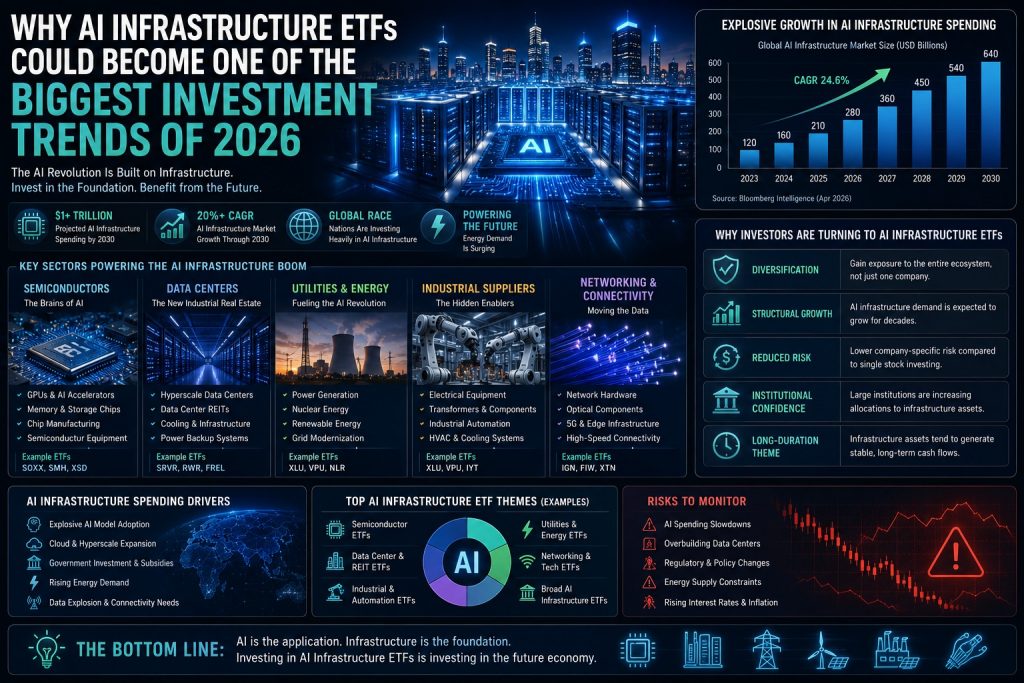
Instead of betting on a single winner, they are investing across the entire ecosystem powering the AI economy.
This includes:
- Semiconductor manufacturers
- Data center operators
- Utility companies
- Industrial suppliers
- Networking hardware firms
- Energy infrastructure providers
- Cloud computing infrastructure
The logic is simple.
No matter which AI software company wins long term, the infrastructure supporting AI demand still needs to expand.
That makes infrastructure exposure one of the most important themes emerging in the 2026 investment landscape.
The AI Economy Needs More Than Software
AI applications may capture public attention.
But infrastructure captures the underlying economic demand.
Every AI model requires:
- Computing power
- Electricity
- Cooling systems
- Data transmission
- Physical data centers
- Semiconductor production
As AI adoption accelerates globally, infrastructure demand compounds alongside it.
This creates opportunities across multiple industries simultaneously.
That is why investors are increasingly looking beyond pure software exposure.
Why ETFs Are Becoming Popular in the AI Sector
The AI market moves extremely fast.
Individual companies can experience enormous volatility.
A single earnings report or regulatory event can erase billions in market value overnight.
ETFs offer diversification inside a sector where uncertainty remains high.
Instead of selecting one AI winner, investors gain exposure across an entire investment theme.
For many investors, this reduces company-specific risk while maintaining long-term exposure to AI growth.
That is particularly attractive in infrastructure sectors where the ecosystem matters more than any individual platform.
Semiconductor ETFs Remain the Core AI Trade
Semiconductors remain the foundation of AI infrastructure.
Without advanced chips, AI systems cannot scale.
That is why semiconductor ETFs continue attracting large institutional flows.
These ETFs often include companies involved in:
- GPU manufacturing
- Memory production
- Chip fabrication
- Semiconductor equipment
- AI accelerators
- Networking processors
The semiconductor supply chain extends far beyond a single company.
As AI demand expands, multiple layers of the chip ecosystem may benefit simultaneously.
Data Center Infrastructure Is Becoming Critical
AI workloads require massive data center expansion.
Modern hyperscale AI facilities consume:
- Huge amounts of electricity
- Advanced cooling systems
- Specialized networking hardware
- Industrial-grade infrastructure
This creates investment opportunities in companies supporting data center growth.
Some infrastructure ETFs now include exposure to:
- Data center REITs
- Industrial cooling companies
- Electrical infrastructure firms
- Cloud infrastructure operators
The AI economy increasingly depends on physical infrastructure capacity.
That makes data centers one of the most important bottlenecks in the industry.
Utility Companies Are Entering the AI Investment Story
One of the biggest surprises of 2026 has been the performance of utility and energy infrastructure companies.
AI data centers require enormous electricity consumption.
As demand rises, utilities are becoming strategically important to AI expansion itself.
This creates a completely different investment framework compared to previous technology cycles.
Investors are now evaluating:
- Nuclear energy providers
- Renewable infrastructure operators
- Grid expansion companies
- Power transmission businesses
Many infrastructure-focused ETFs are beginning to increase exposure to these sectors as AI energy demand accelerates.
Industrial Suppliers Are Quietly Benefiting
The AI boom is also creating demand for industrial suppliers most retail investors rarely discuss.
AI infrastructure requires:
- Transformers
- Cooling systems
- Ventilation equipment
- Electrical hardware
- Industrial construction
- Automation systems
These businesses often operate quietly behind the scenes.
But they are becoming essential to AI expansion.
Some industrial ETFs now indirectly benefit from AI infrastructure spending even without direct software exposure.
Why Institutional Investors Prefer Infrastructure Exposure
Institutional investors increasingly favor infrastructure exposure because infrastructure tends to produce longer-duration revenue streams.
Software leadership can change rapidly.
Infrastructure demand often persists for decades.
A company operating power grids, semiconductor facilities, or data center real estate may continue benefiting regardless of which AI application dominates future markets.
That creates a more stable long-term investment thesis.
For pension funds, sovereign wealth funds, and institutional capital pools, this type of durability matters enormously.
Risks Investors Need To Understand
AI infrastructure ETFs are not risk-free.
Several important risks remain.
Potential concerns include:
- AI spending slowdowns
- Overbuilding data centers
- Semiconductor supply gluts
- Rising interest rates
- Regulatory intervention
- Energy shortages
Infrastructure companies also tend to require heavy capital expenditure.
That can pressure margins during difficult economic periods.
Valuations in some AI-related sectors have already expanded aggressively during 2026.
Volatility remains extremely high.
The Bigger Investment Shift Happening Underneath The Market
The most important development may not be AI software itself.
It may be the return of infrastructure investing.
For years, digital businesses dominated market leadership because software scaled globally with minimal physical constraints.
AI changes that equation.
Physical infrastructure is becoming critical again.
Electricity.
Semiconductors.
Industrial equipment.
Construction.
Cooling systems.
Grid expansion.
These industries suddenly matter deeply to the future of technology.
That may reshape investment leadership for the next decade.
Conclusion
AI infrastructure ETFs represent more than just another technology trend.
They reflect the transformation of AI from a purely digital story into a physical industrial expansion cycle.
The companies enabling:
- Power generation
- Semiconductor manufacturing
- Data center construction
- Industrial automation
- Grid infrastructure
may ultimately become some of the largest beneficiaries of the AI era.
For investors seeking diversified exposure to the long-term AI economy, infrastructure-focused ETFs may become one of the most important themes of 2026 and beyond.
Because regardless of which chatbot, software platform, or AI assistant dominates the future, all of them still require the same foundation underneath:
Infrastructure.
Tags
AI infrastructure ETFs, AI investing, semiconductor ETFs, data center investing, utility stocks, AI infrastructure stocks, industrial ETFs, AI energy demand, cloud infrastructure, ETF investing 2026