Last Updated: April 2026 | Category: AI Investment Trends
Introduction
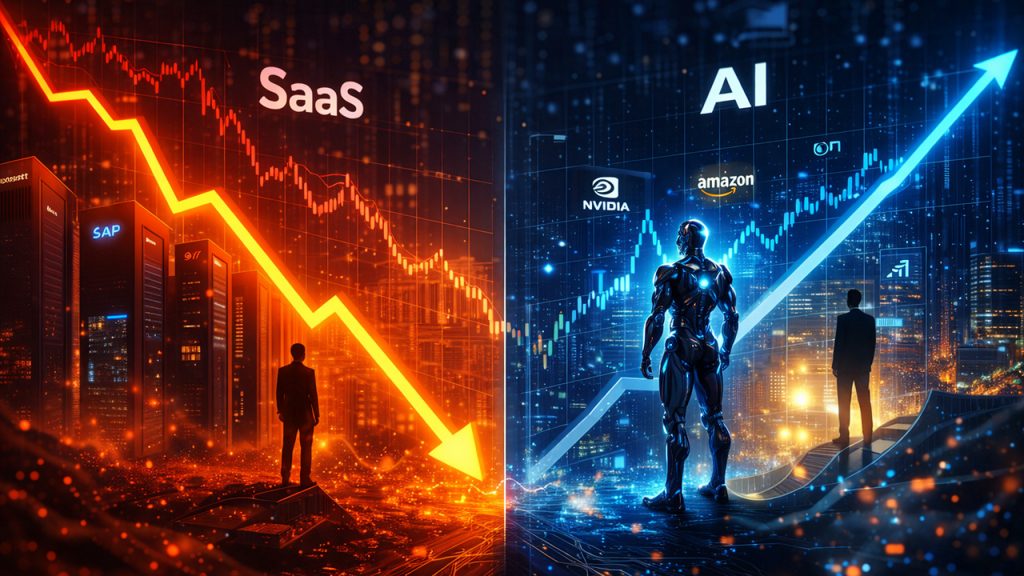
While AI infrastructure stocks are hitting all-time highs in 2026, another part of the tech market is moving in the opposite direction.
Software.
More than $2 trillion in market capitalization has been wiped from enterprise software stocks this year. The iShares Expanded Tech-Software Sector ETF — ticker IGV — recorded its worst quarterly performance since Q4 2008. Software stocks posted their worst relative performance against the S&P 500 in the sector’s entire recorded history.
And yet, some of the most sophisticated investors in the world are stepping in to buy.
This is not a contradiction.
It is the result of one force doing two things at once.
AI is disrupting software — and creating opportunity inside that disruption.
The Collapse: What Actually Happened
The selloff in software has been fast, aggressive, and specific.
IGV fell more than 28% from its September 2025 peak. A separate index of SaaS stocks recorded a year-to-date decline approaching 40% by mid-April. On a single session on April 9, Cloudflare fell 12%, Snowflake fell 9%, ServiceNow fell 7%, and Salesforce slid 4% — all triggered by a Bloomberg report citing two factors: AI app software disruption and private credit concerns.
This isn’t just a correction.
It is a structural repricing — and understanding exactly why it happened is the key to knowing where the opportunity is.
The Core Fear: AI Replaces Seats
Enterprise software was built on an elegant and durable model.
More employees → more software licenses → more revenue.
When a company grew headcount, it needed more Salesforce seats, more Workday licenses, more ServiceNow subscriptions. Revenue expanded automatically. Predictably. Like an annuity.
AI breaks that link.
If AI agents can handle customer service queries, generate reports, automate workflow approvals, and write code — companies need fewer human operators. Fewer human operators means fewer per-seat licenses. Fewer licenses means the revenue model that justified software’s premium valuations for two decades begins to reverse.
That is the fear driving the selloff.
And it is not entirely wrong.
Orlando Bravo — who has spent over 20 years buying and building software companies at Thoma Bravo — said publicly that some software valuations face “very warranted” decreases. Goldman Sachs strategist Ben Snider warned that the selloff may be “the end of the beginning” of a decline, not its end — drawing a parallel to industries like newspapers where disruptive technology caused prolonged earnings declines before stock prices stabilized.
Why the Market May Be Overreacting
The market is treating all software companies as if they face the same threat.
That is the mistake.
Not all software is equally exposed to AI disruption. Not all revenue models are equally dependent on per-seat licensing. And not all price declines reflect deteriorating business fundamentals.
Goldman Sachs CEO David Solomon said it directly at a UBS conference: “The selloff narrative has been too broad. There will be clear winners and losers among software companies rather than a wholesale collapse of the entire sector.”
NVIDIA CEO Jensen Huang was even more direct at the Cisco AI Summit: “This notion that the software industry is in decline and being replaced by AI is the most illogical thing in the world, and time will prove itself.”
The issue is that panicked markets do not make careful distinctions. They sell categories, not companies.
The Split: Winners vs. Losers
AI is not destroying software.
It is dividing it.
High-risk software — the businesses genuinely threatened by AI disruption — share a specific characteristic: their core value proposition is automating tasks that AI agents can now perform directly. Document processing tools. Basic workflow automation. Repetitive data entry software. Simple customer service platforms.
When AI performs these tasks natively, the software layer sitting between human workers and those outcomes loses its justification for existence. The revenue model does not just slow — it potentially reverses.
Durable software operates on different economics. Financial infrastructure like Fiserv processes trillions in transactions under regulatory frameworks that require human auditability and cannot be easily replaced by generative AI. Pharmaceutical compliance workflows like Veeva’s are deeply embedded in regulatory requirements that mandate specific data handling. Creative platforms like Adobe’s are embedding AI directly, making the tools more capable and increasing switching costs rather than reducing them. Financial analytics platforms like MSCI provide benchmarks and indices that institutional investors are contractually required to use.
These businesses are not being disrupted by AI. In many cases, AI is making them more valuable.
The analytical work required of investors is not “is this company in software?” — it is “does AI replace this company’s specific value proposition, or does it enhance it?”
Why Smart Money Is Buying
On April 16, Michael Burry — the Scion Asset Management founder who predicted the 2008 housing collapse — published a Substack post publicly explaining why he was buying software stocks.
He opened a 3.5% position in PayPal. He maintained holdings in Fiserv, Adobe, Autodesk, and Veeva Systems. He planned to add Salesforce and MSCI.
His thesis was precise: “I do not believe the technical pressures brought on by the private credit/software debt issues are big enough to affect these stocks for much longer.”
Not all declines are fundamental. Burry identified a “reflexive positive feedback loop” — falling equity prices creating stress in bank debt tied to software companies, triggering forced selling, which drove prices lower still — entirely independent of whether the underlying businesses were deteriorating.
PayPal rose 2.5% following the disclosure. Activist investor speculation added to the move, with SG Americas’ 13F filing flagging PayPal as a potential intervention target.
Goldman Sachs simultaneously launched a custom pair-trade basket for the AI-disruption theme — long companies with physical execution requirements, regulatory moats, and high switching costs; short companies whose core workflows face direct AI substitution. The bank’s research desk released specific buy-rated names and a framework for distinguishing the durable from the genuinely threatened.
When both the contrarian legend known for the Big Short and Wall Street’s most influential research desk are simultaneously making the same analytical distinction, that is worth understanding.
The Hidden Driver: Technical Selling
Part of the software decline is not even about fundamentals.
The private credit market — which accounted for an estimated 30% of the U.S. leveraged finance market in 2025 — has significant exposure to software borrowers. As retail investors withdrew money from private credit funds over recent months, the resulting stress in loans tied to software companies created forced selling pressure that amplified the equity decline.
Morgan Stanley projected private credit defaults in the software sector could reach approximately 8% — meaningful, but not catastrophic.
Burry’s specific picks share one characteristic that directly addresses this risk: none of them rely on private credit markets for financing. PayPal, Fiserv, Adobe, Autodesk, and Veeva are cash-generating businesses insulated from the specific technical mechanism that amplified the selloff.
When the private credit stress cycle resolves — and Burry believes it will — the technical selling pressure dissipates. Businesses with sound fundamentals that survived the cycle intact are positioned to recover.
AI Is Also the Recovery Engine
Here is the insight most coverage of the software selloff has missed.
AI is simultaneously the cause of the selloff and the mechanism for recovery — for the right companies.
Adobe has integrated AI image generation directly into its creative platform through Firefly, deepening the value proposition rather than undermining it. Salesforce has deployed AI agents within its CRM, moving from workflow management toward intelligent business automation — expanding its addressable market rather than shrinking it. Veeva’s pharmaceutical compliance workflows become more data-intensive and complex as AI accelerates drug discovery, increasing rather than decreasing the value of purpose-built compliance infrastructure.
PepsiCo’s deployment of AI digital twins in partnership with NVIDIA and Siemens — generating 20% improvement in throughput and 10-15% capex reduction — is powered by data infrastructure and workflow platforms. AI tools that generate measurable business outcomes require enterprise software to implement, integrate, and govern them.
The companies that embed AI into their platforms and demonstrate measurable productivity improvements are not getting disrupted.
They are getting leverage.
Why This Matters Now
The broader market is at all-time highs.
The S&P 500 and Nasdaq hit records in April. Systematic hedge funds added $86 billion in equity exposure in five sessions — one of the fastest buying paces Goldman Sachs has recorded. AI infrastructure stocks have returned 44% year-to-date against only 9% earnings estimate growth.
And software is trading near three-year lows.
Microsoft is down 18% in 2026 — tied with Tesla for worst performer among the Magnificent Seven. Oracle is down 14%. The sector that generated the most consistent premium valuations in technology for two decades is now trading at or below the S&P 500 multiple — something that has not happened in this sector’s recorded history.
That divergence does not persist indefinitely.
Either software fundamentals deteriorate in ways that validate the selloff narrative — meaning AI disruption is deeper and faster than current financials suggest — or prices recover as the narrative overshoots reality and earnings reports demonstrate that the strongest companies are intact.
Right now, smart money is betting on the second scenario, selectively.
The Real Strategy
This is not a “buy all software” moment.
It is a selection moment.
Goldman Sachs’ framework provides the analytical structure:
Long — companies whose businesses require physical execution, regulatory entrenchment, mission-critical integrations, or human accountability that AI cannot easily replicate.
Short — companies whose core workflows face direct substitution risk from AI agents, whose revenue depends on human seat counts in tasks AI now performs natively, and whose private credit exposure creates additional financial vulnerability.
The key question for every software holding is not “is AI growing?” — it is “does AI replace this company’s specific value proposition, or does AI increase it?”
That distinction determines everything.
Key Risk to Watch
Not all software will recover.
Some business models are genuinely impaired — not temporarily mispriced.
The companies whose revenue depends on automating workflows that AI now performs better, faster, and cheaper have a structural problem that is not resolved by a private credit cycle turning. For those companies, the selloff is not a buying opportunity. It is a warning.
Burry acknowledged this directly: he is buying specific companies whose businesses are insulated from AI disruption — not the sector indiscriminately.
Investors who buy software broadly because prices have fallen will own both the companies that recover and the ones that do not. Distinguishing between them is the actual work.
Conclusion
AI is reshaping the software sector in real time.
It is destroying outdated models — the per-seat licensing businesses whose revenue depends on human workers performing tasks AI can now perform natively. More than $2 trillion in market capitalization has been repriced to reflect that reality.
And it is strengthening the right ones — the financial infrastructure platforms, regulatory compliance systems, deeply embedded enterprise tools, and creative platforms that embed AI as leverage rather than facing it as a threat.
The selloff is not just fear. It is transition.
Inside every transition, there are losers that disappear permanently, winners that compound through the disruption, and opportunities most investors miss because they react to the narrative instead of analyzing the businesses.
Burry’s 3.5% PayPal position. Goldman’s custom pair-trade basket. NVIDIA’s Jensen Huang publicly defending software’s future. These are not random signals.
They are experienced investors making the same distinction the market has not yet made carefully.
The investors who benefit are not those who bought software because it fell.
They are those who understood which software to buy — and why.
This article is for informational purposes only and does not constitute financial or investment advice. Always consult a qualified financial professional before making investment decisions.