Introduction
Three developments published within days of each other in mid-April 2026 paint a more complete and nuanced picture of where AI is heading than any single headline can capture.
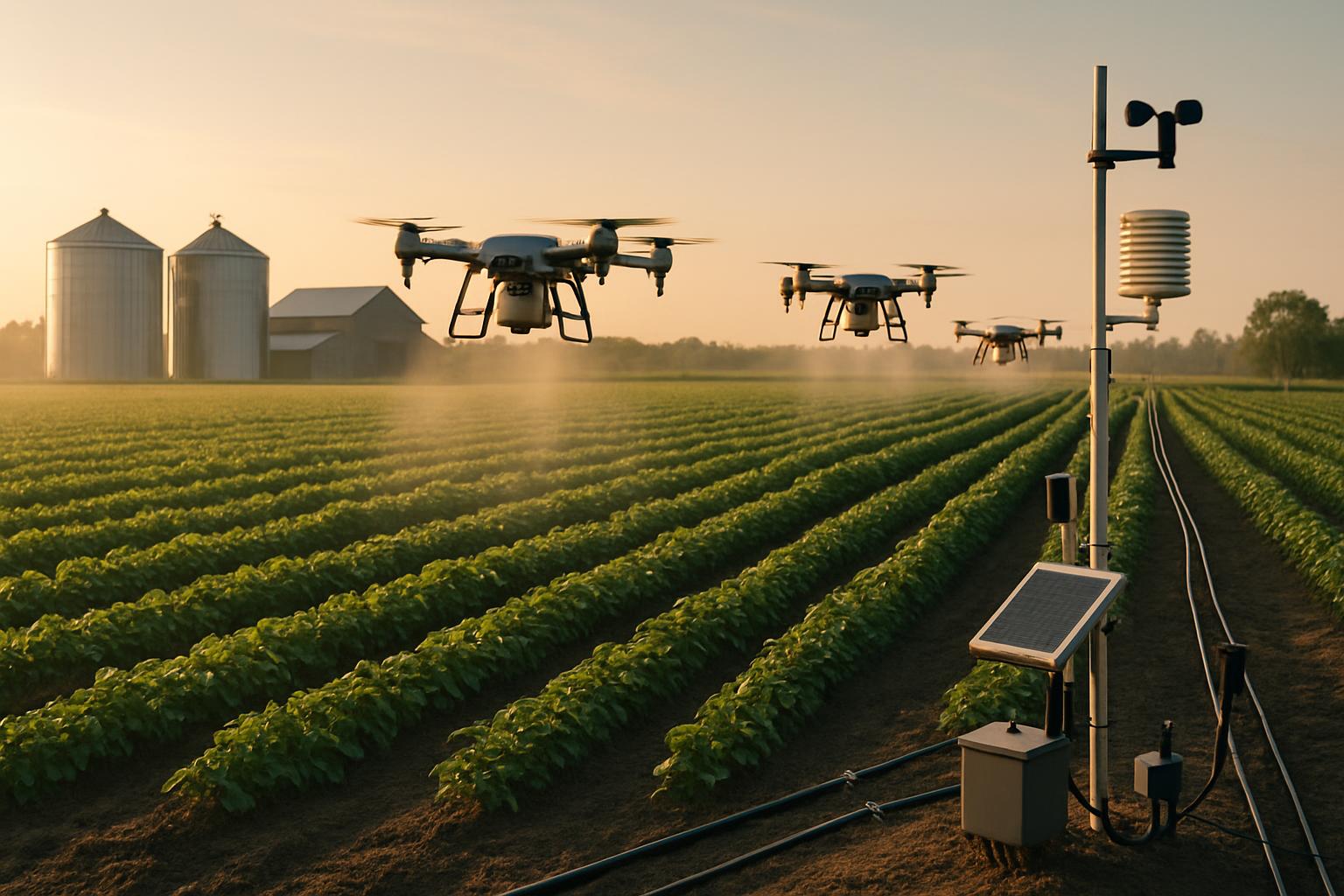
A Singapore-based joint venture announced a new class of agricultural drone that removes the need for pre-flight mapping entirely by using real-time AI vision to navigate plantation terrain autonomously with centimetre-level precision. Stanford University’s annual AI Index Report delivered one of its most consequential geopolitical findings to date: the U.S.-China performance gap in frontier AI models has effectively closed. And within the same report was another critical finding: documented AI incidents rose 56% year over year, governance responses are deteriorating, and most frontier AI models still report little or nothing on responsible AI benchmarks.
Together, these developments offer a more realistic view of the AI landscape in 2026.
Map-Free Agricultural AI: What It Actually Solves
The agricultural drone market has existed for years, but conventional spraying drones still depend heavily on pre-flight mapping.
That requirement creates labor overhead and reduces efficiency in environments where terrain and crop conditions change constantly.
The new generation of AI-enabled agricultural drones solves this by using:
– real-time vision systems
– centimetre-level positioning
– dynamic altitude and route adjustment
– live canopy and terrain analysis
This changes the economics of industrial-scale agriculture.
Instead of relying on static maps, the drone adapts during flight. It can spray, monitor, collect agronomic data, and support precision farming decisions at the same time.
For investors, this shows that physical AI is no longer limited to factories and warehouses. It is moving into highly variable, real-world environments such as agriculture.
The U.S.-China AI Gap Has Narrowed
One of the most important findings in Stanford’s 2026 AI Index is that the performance gap between leading U.S. and Chinese frontier AI models has narrowed dramatically.
This does not mean the United States has lost its broader AI advantages. The U.S. still leads in private capital, data center capacity, startup formation, and many high-impact commercial deployments.
However, the assumption that the U.S. holds a large and durable performance lead is no longer clearly supported.
China continues to lead in several important areas:
– research publication volume
– patent output
– industrial robot deployment
– large-scale state-backed infrastructure support
This changes the competitive framework for investors.
AI is no longer a one-country story. It is a global competition with multiple centers of capability and capital.
The Responsible AI Gap
The Stanford report also highlights a second major issue that deserves investor attention.
AI capability is advancing faster than AI governance.
The report shows:
– documented AI incidents rose sharply
– organizational incident response quality declined
– most frontier models provide limited responsible AI benchmark reporting
This creates a structural risk.
As AI becomes more capable and more widely deployed, the cost of poor governance grows. That cost can appear as regulatory pressure, legal exposure, reputational damage, or enterprise adoption friction.
For investors, this means governance is not a side issue. It is becoming part of the competitive moat.
The Public Trust Problem
Another important signal is the widening gap between expert optimism and public trust.
Experts tend to see AI as beneficial for productivity and economic growth. The public is much more cautious.
At the same time, AI adoption continues to rise quickly.
This combination — rapid adoption with weak trust — often leads to stronger regulation later.
For investors, that matters because future rules around safety, accountability, transparency, and deployment could materially affect the economics of AI businesses.
What These Three Trends Mean Together
These three stories are connected.
– Physical AI is moving into real commercial environments
– global AI competition is broader than many investors assumed
– governance systems are lagging behind deployment speed
This means the AI opportunity set is expanding, but so are the risks.
The next phase of AI investing is not only about model performance. It is about:
– real-world deployment
– global competitive positioning
– governance and compliance infrastructure
Key Investment Themes
Several durable themes emerge from these developments.
Physical AI
AI systems are increasingly moving beyond software into agriculture, logistics, robotics, and industrial automation.
Global diversification
The narrowing performance gap between major AI powers suggests investors should avoid overly narrow geographic assumptions.
Governance infrastructure
Companies building safety, compliance, monitoring, rollback, and responsible AI tools may become increasingly valuable as enterprise deployment grows.
Conclusion
AI in 2026 is more capable, more globally competitive, more physically embedded, and more governance-constrained than many market narratives fully reflect.
The commercial opportunity continues to expand, but so does the need for better frameworks around trust, accountability, and safe deployment.
For investors, the key is not just to follow the most visible AI companies, but to understand where value is being created across the broader ecosystem — and where the next major constraints are likely to emerge.
Those who can see both the growth story and the governance story clearly are likely to be better positioned in the years ahead.