It’s Not Too Late to Invest in AI — Understanding the Real Opportunity in 2026
Artificial intelligence is no longer a future concept. It is already reshaping industries, economies, and financial markets across the world — and doing so at a speed that has consistently exceeded even the most optimistic forecasts.
As recently as 2022, AI was primarily a research-stage technology with limited commercial deployment. By early 2026, eight of the ten largest companies on the Fortune 10 are using advanced AI systems. Major AI companies have reached tens of billions in annual revenue, and the five largest U.S. technology companies have collectively committed between $660 billion and $690 billion in capital expenditure for 2026 alone, the vast majority directed at AI infrastructure.
For investors asking whether they have missed the AI opportunity, the data suggests otherwise. A significant portion of global AI-related investment is still ahead, indicating that the opportunity is far from over.
Why Most Investors Are Looking in the Wrong Place
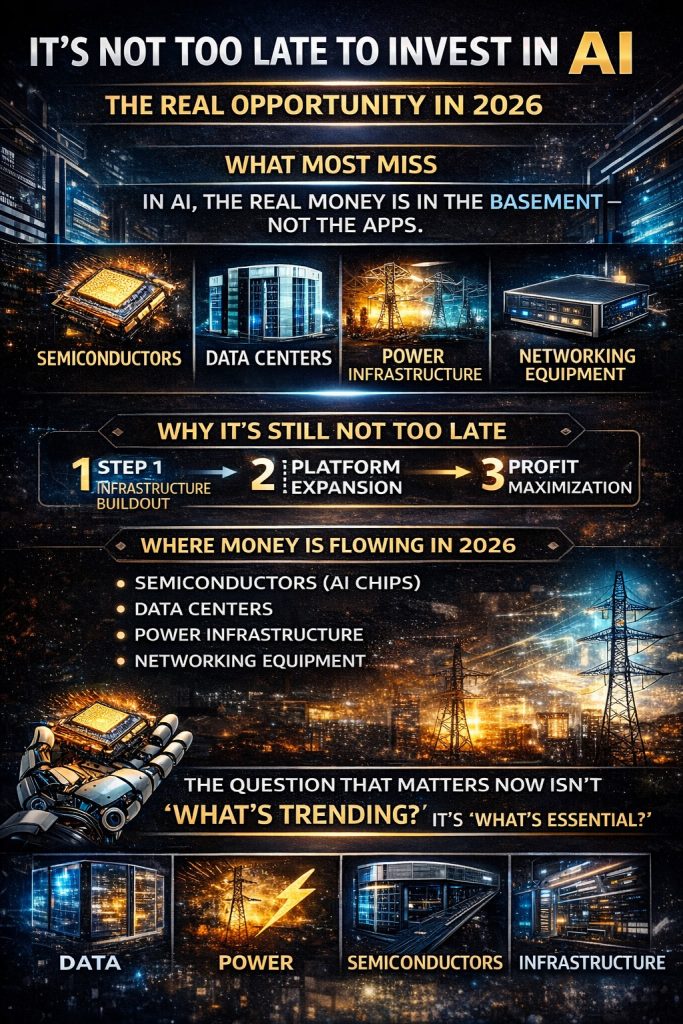
The most visible AI developments are consumer-facing products such as chatbots, automation tools, and content generators. While these innovations attract attention, they represent only a small portion of the total value being created.
The deeper opportunity lies in the infrastructure layer that supports all AI systems.
Infrastructure companies have significantly outperformed expectations, not because of short-term earnings, but because investors recognize long-term structural demand.
The Foundation: What AI Infrastructure Includes
Every AI system depends on foundational components that enable it to operate at scale.
These include:
- Semiconductor chips designed for AI workloads
- Large-scale data centers
- Cloud computing platforms
- Energy and power infrastructure
- High-speed networking systems
Without these components, AI systems cannot function effectively.
The Three Stages of AI Development
Technology cycles typically follow three stages:
- Infrastructure development
- Platform expansion
- Profit optimization
As of 2026, AI is still largely in the first and second stages. Infrastructure is still being built, and platforms are still expanding. This suggests that long-term growth has not yet fully materialized.
Expansion Across Industries
AI adoption is expanding across multiple sectors, including finance, healthcare, logistics, and manufacturing.
Each new use case increases demand for infrastructure, creating a compounding effect across the global economy.
The More AI Is Used → The More Infrastructure Is Needed
This creates a self-reinforcing cycle of growth.
The Overlooked Beneficiaries
While large AI companies receive most of the attention, many less visible sectors benefit directly from AI expansion.
These include:
- Energy and power companies
- Data center real estate
- Semiconductor supply chains
- Construction and infrastructure services
- Networking equipment providers
These sectors benefit regardless of which AI company becomes dominant.
Addressing the “Too Late” Question
The belief that it is too late to invest in AI is not supported by current data.
Infrastructure investment remains in an early phase relative to its long-term potential. Demand continues to exceed supply in many areas, particularly in computing power and energy capacity.
This indicates that the growth cycle is still ongoing.
Key Risks to Understand
Despite strong growth, risks remain.
- High valuation levels
- Potential slowdown in capital expenditure
- Technological changes that reduce infrastructure demand
- Energy supply limitations
- Market concentration risks
Understanding these risks is essential for making informed decisions.
Conclusion
Artificial intelligence represents a long-term transformation rather than a short-term trend.
The most consistent opportunity lies in the infrastructure that supports AI, not just in the applications themselves.
As long as AI adoption continues to expand, the demand for its underlying systems is likely to remain strong.
For investors, focusing on long-term structural demand rather than short-term trends provides a more stable approach to navigating the AI investment landscape.