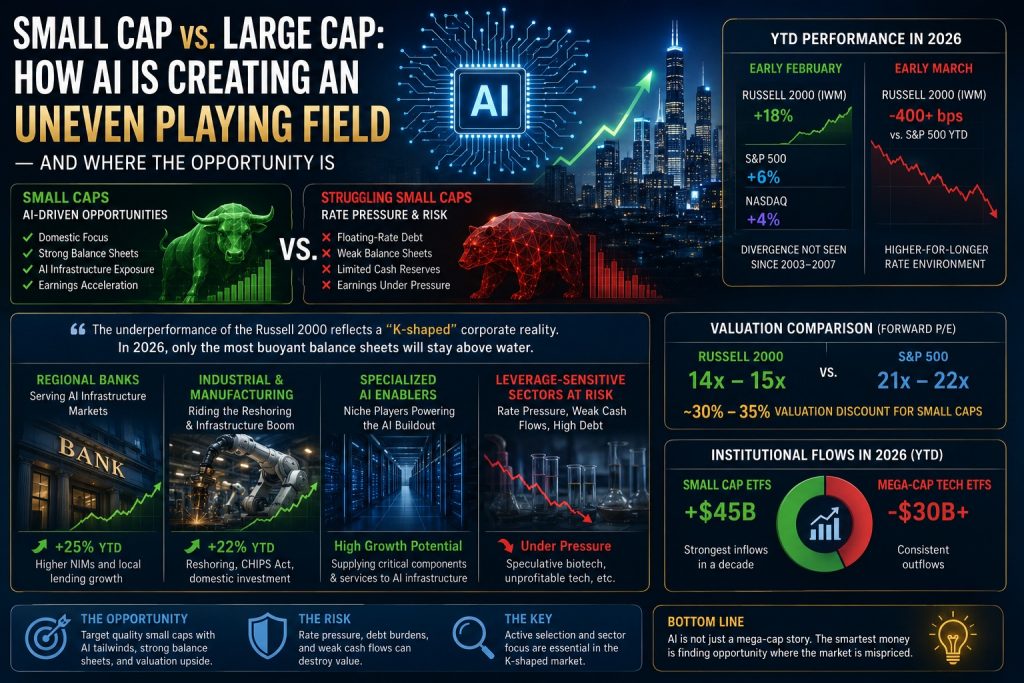
Small Cap vs. Large Cap: How AI Is Creating an Uneven Playing Field — And Where the Opportunity Is
Last Updated: April 2026 | Category: AI Investment Trends
Introduction
2026 has produced one of the most unusual market splits in recent memory.
The S&P 500 and Nasdaq hit record highs in April. Mega-cap AI stocks drove extraordinary returns. The market, by headline metrics, looks healthy.
But beneath the surface, a different story has been playing out.
In early March 2026, the Russell 2000 — the benchmark for small-cap stocks — lagged its large-cap counterparts by over 400 basis points since the start of the year.
The divergence highlights the fragile state of smaller public companies in a higher-for-longer interest rate environment.
Then, in a reversal that illustrated the instability of the small-cap outlook, earlier data from February had shown the opposite:
Year-to-date as of early February, IWM — the iShares Russell 2000 ETF — returned 18% while the S&P 500 gained just 6% and the Nasdaq 4%.
Up 12 percentage points against the S&P 500 in February. Down 400 basis points against it in March.
The small-cap market in 2026 is not simply underperforming or outperforming large caps.
It is splitting violently between small companies benefiting from AI-driven structural tailwinds and small companies being crushed by the interest rate environment that the same AI investment cycle is helping sustain.
Understanding that split is the key to the entire small-cap AI opportunity in 2026.
📷 이미지 위치 1
Futuristic financial city with AI hologram dividing green bullish small caps and red struggling companies
The K-Shaped Reality: Why Small Caps Are Diverging
The term “small-cap performance” in 2026 is almost meaningless without deeper analysis.
The underperformance of the Russell 2000 reflects a K-shaped corporate reality.
At the top of the K:
- Small companies with strong balance sheets
- Domestic revenue exposure
- AI infrastructure connections
- Regional economic advantages
- Industrial and manufacturing exposure
These businesses are experiencing genuine earnings acceleration.
At the bottom of the K:
- Companies with floating-rate debt
- Weak cash reserves
- Unprofitable operations
- Businesses dependent on cheap capital
These companies are being aggressively repriced lower.
The clear winners in the small-cap universe include:
- Financials up 25% year-to-date
- Industrials up 22% year-to-date
The biggest losers are concentrated in leverage-sensitive sectors like speculative biotech and unprofitable software businesses.
For investors, this K-shape is not merely market noise.
It is the investment opportunity itself.
The Valuation Case: Small Caps vs. Large Caps
The valuation gap between small and large caps in 2026 is substantial.
The S&P 500 trades around 21 to 22 times forward earnings.
The Russell 2000 trades closer to 14 to 15 times forward earnings excluding negative earners.
That represents roughly a 30% to 35% valuation discount.
Historically, small-cap stocks have outperformed large caps by approximately 2 percentage points annually over long periods due to:
- Higher volatility
- Lower liquidity
- Less analyst coverage
- Greater growth potential
In 2026, mega-cap AI dominance has widened that gap further.
The Russell 2000 is projected to grow earnings by 22% in 2026 compared to roughly 15% for large-cap stocks.
That combination matters:
Higher projected earnings growth.
Lower valuation multiple.
That is the core arithmetic behind the small-cap opportunity.
How AI Is Creating Specific Small-Cap Winners
The AI infrastructure boom is not only helping trillion-dollar technology giants.
It is creating opportunities for smaller companies positioned inside the supply chain.
Regional Banks
Regional banks are benefiting from AI infrastructure construction occurring across:
- Texas
- Northern Virginia
- Ohio
- Arizona
- Georgia
Data center construction drives:
- Commercial lending
- Property development
- Local employment
- Infrastructure financing
Regional banks with strong local exposure are capturing this economic activity faster than giant money-center banks.
Industrial & Manufacturing Companies
AI has accelerated semiconductor reshoring in the United States.
The CHIPS Act, combined with supply chain restructuring, is fueling domestic manufacturing growth.
Small-cap industrial firms are benefiting from:
- Factory construction
- Infrastructure spending
- Equipment demand
- Domestic manufacturing incentives
Industrials within the Russell 2000 are experiencing a genuine manufacturing renaissance.
Specialized AI Infrastructure Suppliers
Many AI-critical suppliers remain too small for S&P 500 inclusion.
Examples include companies specializing in:
- Cooling systems
- Sensors
- Semiconductor components
- Ventilation systems
- Electrical infrastructure
These niche businesses may be strategically essential to the AI buildout long before their valuations fully reflect it.
📷 이미지 위치 2
AI data center construction site with industrial robotics and regional bank financial overlays
The Rate Sensitivity Problem
The small-cap AI opportunity is real.
So is the risk.
Many small-cap companies carry floating-rate debt.
As the Federal Reserve keeps interest rates elevated around 3.5% to 3.75%, borrowing costs continue rising for weaker companies.
Large-cap technology companies locked in cheap fixed-rate financing years ago.
Many Russell 2000 businesses did not.
This creates a major divide:
Strong balance sheets survive.
Weak balance sheets struggle.
A low P/E ratio is not attractive if the company cannot comfortably service its debt.
That is why balance sheet quality is the most important filter for small-cap investing in 2026.
The AI Adoption Asymmetry
AI is creating an underappreciated asymmetry among small businesses.
Some companies are using AI to become more productive and competitive.
Others are being directly disrupted by AI.
A regional bank using AI for underwriting can improve:
- Loan processing speed
- Default prediction
- Operational efficiency
- Customer service
At the same time, companies providing repetitive administrative workflows or outdated software services may face direct disruption from AI automation.
This divergence is accelerating the K-shaped split inside the small-cap market.
The Historical Pattern
Historically, periods of mega-cap technology dominance are often followed by rotations into smaller companies.
One relevant example is the post-dot-com period between 2003 and 2007.
Following the collapse of speculative technology valuations, capital rotated into:
- Domestic industrials
- Financials
- Mid-cap growth businesses
- Value-oriented sectors
The early 2026 small-cap rally briefly resembled that historical pattern before macro uncertainty interrupted momentum.
Whether the rotation fully develops depends heavily on:
- Federal Reserve policy
- Rate cuts
- Earnings expansion beyond mega-cap tech
- Continued AI infrastructure spending
Practical Framework for Investors
Several principles matter when evaluating small-cap exposure in the AI era.
1. Balance Sheet Quality Comes First
Focus on companies with:
- Net cash positions
- Low floating-rate debt
- Positive free cash flow
- Stable margins
2. Sector Selection Matters More Than Market Cap
Owning small-cap industrials tied to AI infrastructure is very different from blindly owning the entire Russell 2000 index.
Selective exposure matters.
3. Valuation Alone Is Not Enough
A discount is only attractive if the company survives long enough for the market to recognize value.
4. Position Sizing Matters
Small-cap volatility can be extreme.
Even strong businesses may experience 30% to 40% drawdowns during macro stress periods.
Risk management is essential.
Conclusion
The small-cap versus large-cap debate in 2026 is not simply about which category outperforms.
It is about identifying the specific businesses positioned at the intersection of:
- AI infrastructure expansion
- Domestic economic growth
- Strong balance sheets
- Attractive valuations
Institutional investors appear to recognize this shift already.
Small-cap ETFs absorbed tens of billions in inflows during early 2026 while mega-cap technology funds experienced persistent outflows.
The setup is compelling:
- Higher projected earnings growth
- Significant valuation discounts
- Structural AI tailwinds
But success in small-cap investing during the AI era requires precision.
The winners are unlikely to be broad index averages.
They are likely to be the specific regional banks, industrial suppliers, infrastructure firms, and AI-adjacent businesses quietly benefiting from the largest technology infrastructure cycle in decades.
That is where the small-cap premium may actually be earned in 2026.
Tags
small cap stocks, large cap stocks, Russell 2000, AI investing, small cap AI stocks, AI infrastructure, regional banks, industrial stocks, AI market trends, stock market 2026