Introduction
The biggest AI companies in the world are not publicly traded.
OpenAI, Anthropic, and xAI are building the foundational models shaping the global economy. Yet, most investors cannot access them through traditional brokerage accounts.
This is not a coincidence.
It reflects a structural shift in where value is created and captured.
In 2026, private capital is driving the AI revolution.
The Scale of Private AI Capital
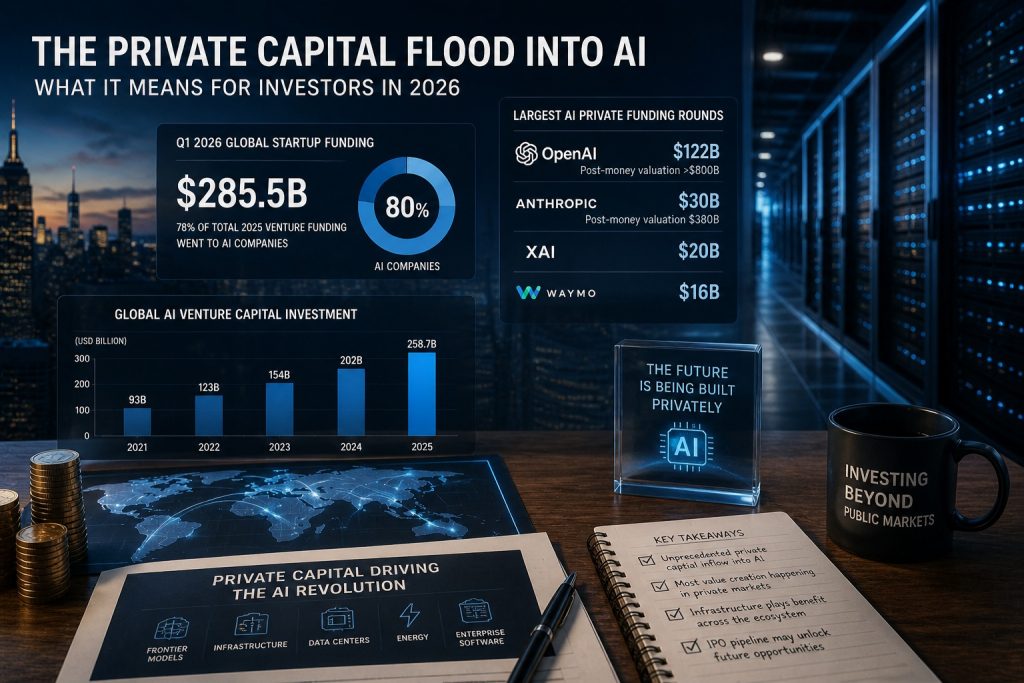
Private AI investment has reached unprecedented levels.
Venture funding has surged, with a large portion directed toward AI companies. Capital is flowing at a scale never seen before.
This changes the investment landscape.
The most significant developments are happening outside public markets.
Capital Concentration
Investment is highly concentrated.
A small number of companies are receiving the majority of funding. These large rounds dominate the market, leaving smaller players with limited resources.
This creates a gap.
Not all AI companies are equal, and capital allocation reflects that reality.
Private Equity Strategy
Private equity firms are approaching AI differently.
Instead of focusing only on frontier models, they invest in infrastructure and supporting systems. Data centers, energy systems, and enterprise software are key areas.
This strategy reduces risk.
It also provides exposure to the broader AI ecosystem.
The Role of Private Credit
Private credit is another important layer.
Non-bank lenders are financing AI infrastructure projects. This provides capital where traditional banking may not.
However, it introduces complexity.
Market stress in private credit can affect public markets indirectly.
IPO Pressure and Future Access
Private capital creates a pipeline.
Investors expect eventual exits through IPOs or acquisitions. As valuations increase, the pressure to provide liquidity grows.
This means future opportunities.
Public investors may gain access as these companies enter public markets.
What Public Investors Can Access
Despite limitations, opportunities exist.
Public companies involved in AI infrastructure provide indirect exposure. Cloud providers, semiconductor firms, and energy companies all benefit from AI growth.
Alternative asset managers also offer access.
Their performance is linked to private market activity.
Risks to Consider
Private capital concentration creates risks.
Valuations may not reflect long-term fundamentals. Market corrections can occur when expectations change.
Capital allocation may also be inefficient.
Not all investments will succeed.
Conclusion
Private capital is shaping the AI investment landscape.
While public investors cannot directly access many leading AI companies, they can participate through related sectors.
Understanding these dynamics is essential.
The AI revolution is being funded privately, but its impact is visible across all markets.
This article is for informational purposes only and does not constitute financial or investment advice. Always consult a qualified financial professional before making investment decisions.