Introduction
Markets in 2026 feel highly efficient.
Information is everywhere. Prices react instantly. AI systems process earnings transcripts, satellite data, and geopolitical signals at a scale no individual analyst can match.
For many investors, this raises a simple and uncomfortable question.
Is there any edge left?
The answer is yes.
Sophisticated investors are still generating meaningful alpha in what many assume is an impossibly efficient market. But the edges they are exploiting are not the ones that worked a decade ago.
They have evolved.
Why Traditional Edges Have Disappeared
A decade ago, access to data created advantage.
Today, most of those barriers have collapsed. Alternative data, earnings insights, and market signals are widely available. The edge is no longer about access.
It is about interpretation.
Speed has also changed the game. Algorithmic trading dominates modern markets, making it nearly impossible for individual investors to compete on execution speed.
The old edges — information scarcity and slower execution — no longer work.
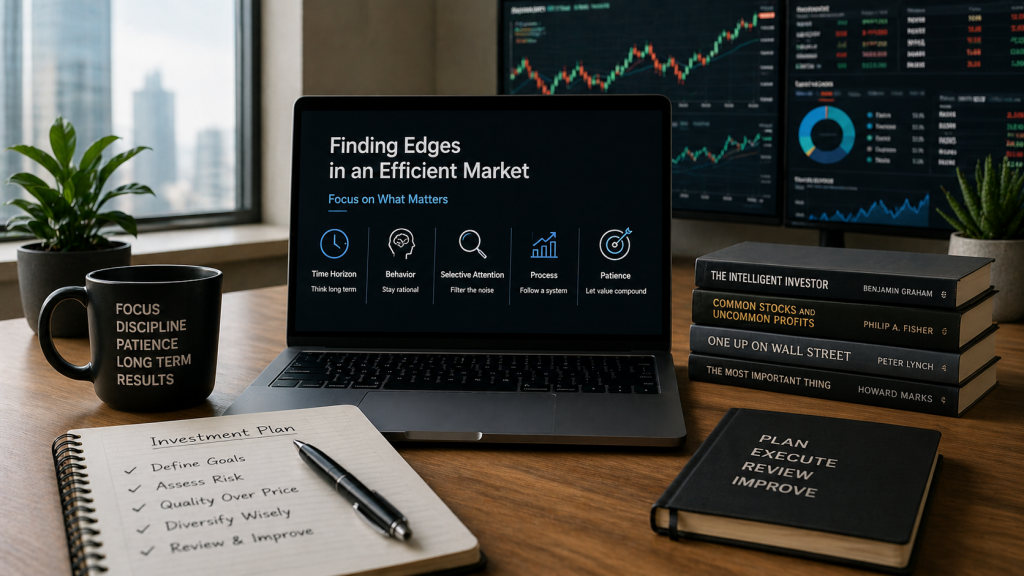
Edge One: Time Horizon
One of the most powerful edges in 2026 is time.
Many market participants focus on short-term outcomes. This creates pricing inefficiencies for assets whose value develops over longer periods.
Short-term pressure leads to mispricing.
Investors who can think in multi-year horizons can take advantage of this gap.
Edge Two: Behavioral Discipline
The second edge is behavior.
Emotional investing remains one of the biggest weaknesses in the market. Fear, panic, and FOMO continue to drive decisions for a large portion of investors.
This creates predictable mistakes.
Disciplined investors who avoid emotional reactions benefit from these mispricings. They buy when others are fearful and remain stable when volatility increases.
Edge Three: Selective Attention
In a world overloaded with data, attention becomes valuable.
Investors who focus on key drivers — revenue growth, margins, competitive advantage — outperform those reacting to constant news and noise.
Not every signal matters.
Filtering information effectively creates clarity, and clarity leads to better decisions.
Edge Four: Process Consistency
A consistent investment process is a structural advantage.
Investors who follow clear rules — entry criteria, risk management, portfolio allocation — avoid the emotional swings that lead to poor decisions.
Consistency creates reliability.
Over time, process-driven investing produces more stable outcomes than reactive decision-making.
Where Opportunities Still Exist
Even in efficient markets, specific opportunities continue to appear.
AI adoption is creating winners and losers across industries. Some companies are gaining real advantages, while others are simply following trends.
Markets do not always price this difference correctly.
Sector-wide narratives also create distortions. Entire industries can move together even when individual company fundamentals differ significantly.
These moments create entry points.
The Limits of Edge
Not all areas offer an advantage.
Market timing at the index level remains extremely difficult. Short-term price prediction is largely dominated by algorithms. Narrative-driven investing often leads to poor outcomes.
Understanding where edge does not exist is just as important as finding where it does.
Conclusion
Alpha has not disappeared.
It has changed.
In 2026, the most reliable edges come from time horizon, behavioral discipline, selective attention, and process consistency.
Markets may be faster and more efficient than ever.
But human behavior has not changed.
And that gap is where opportunity remains.
This article is for informational purposes only and does not constitute financial or investment advice. Always consult a qualified financial professional before making investment decisions.