Introduction
AI stocks have been among the strongest-performing segments of the market over the past two years. Even through periods of geopolitical uncertainty, interest rate pressure, and sector rotation, many AI-related companies have continued attracting institutional capital at a scale that surprises even experienced investors.
Most explanations focus on the obvious reason: AI is a major technological shift, and investors want exposure to growth. While this is true, it does not fully explain why certain AI stocks continue rising even when sentiment weakens or individual AI applications fail to meet expectations.
The real explanation runs deeper — and many investors are still overlooking it.
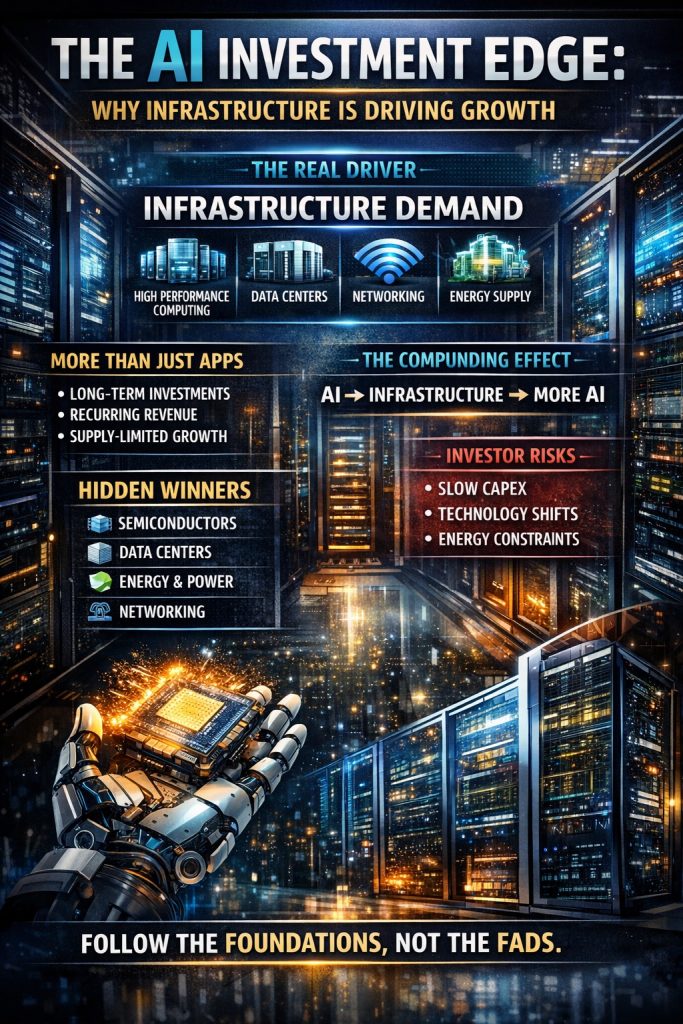
The Real Driver: Infrastructure Demand
The biggest force pushing AI stocks higher is not consumer applications or trending AI tools.
It is infrastructure.
Every AI system depends on:
- high-performance computing power
- large-scale data storage
- high-speed networking
- massive energy consumption
This demand is not temporary. It is structural.
Major technology companies are committing hundreds of billions of dollars into AI infrastructure. These are not speculative investments. They are long-term capital commitments backed by real contracts, data center construction, and power supply agreements.
More importantly, these companies are not demand-limited. They are supply-limited.
This means the growth is constrained not by lack of interest, but by how fast infrastructure can be built.
The Semiconductor Multiplier Effect
AI infrastructure investment directly translates into semiconductor demand.
Advanced chips designed for AI workloads are becoming the most valuable segment of the semiconductor industry.
A small percentage of total chip volume now generates a large portion of industry revenue, showing how value is concentrating in AI-related hardware.
This explains why semiconductor companies have been among the biggest beneficiaries of the AI boom.
Why Infrastructure Stocks Keep Rising
Infrastructure-related companies have outperformed because their demand visibility is unusually strong.
Unlike consumer-facing AI products, infrastructure demand is driven by long-term contracts and capital commitments.
This creates:
- predictable revenue streams
- multi-year growth visibility
- lower dependence on short-term trends
Investors are pricing in future demand before it fully appears in earnings reports.
The Compounding Effect Across Industries
AI is not limited to one sector.
It is expanding across:
- finance
- healthcare
- logistics
- manufacturing
Each new use case increases demand for infrastructure.
This creates a reinforcing cycle:
more AI adoption → more infrastructure demand → more investment → more AI capability
The Less Visible Winners
While attention is focused on major AI brands, many of the strongest opportunities exist in less visible areas:
- semiconductor supply chain
- data center infrastructure
- energy and power systems
- networking equipment
- industrial construction
These sectors benefit regardless of which AI company leads in applications.
Why Investors Still Miss This
Many investors focus on what is visible.
They follow headlines, trends, and short-term price movements.
But the real value is often created behind the scenes.
Infrastructure companies do not always attract attention, but they capture consistent demand.
Key Risks to Consider
Despite strong momentum, risks remain.
- slowing capital expenditure growth
- high current valuations
- technological shifts reducing compute demand
- energy and power constraints
- changes in AI efficiency
These factors can impact returns, especially if expectations are already priced into the market.
A Practical Investment Approach
Investors focusing on AI infrastructure often follow a structured approach:
- track capital expenditure trends from major tech companies
- diversify across different layers of the AI ecosystem
- identify companies with recurring demand rather than one-time sales
- look beyond headline AI companies
This helps reduce risk while maintaining exposure to long-term growth.
Conclusion
AI stocks continue rising in 2026 not simply because of hype, but because of one of the largest infrastructure buildouts in modern economic history.
The companies driving this growth are not just building products. They are building the foundation of the future digital economy.
As long as demand for AI continues to expand, the infrastructure supporting it is likely to remain one of the most important and resilient investment themes in the market.