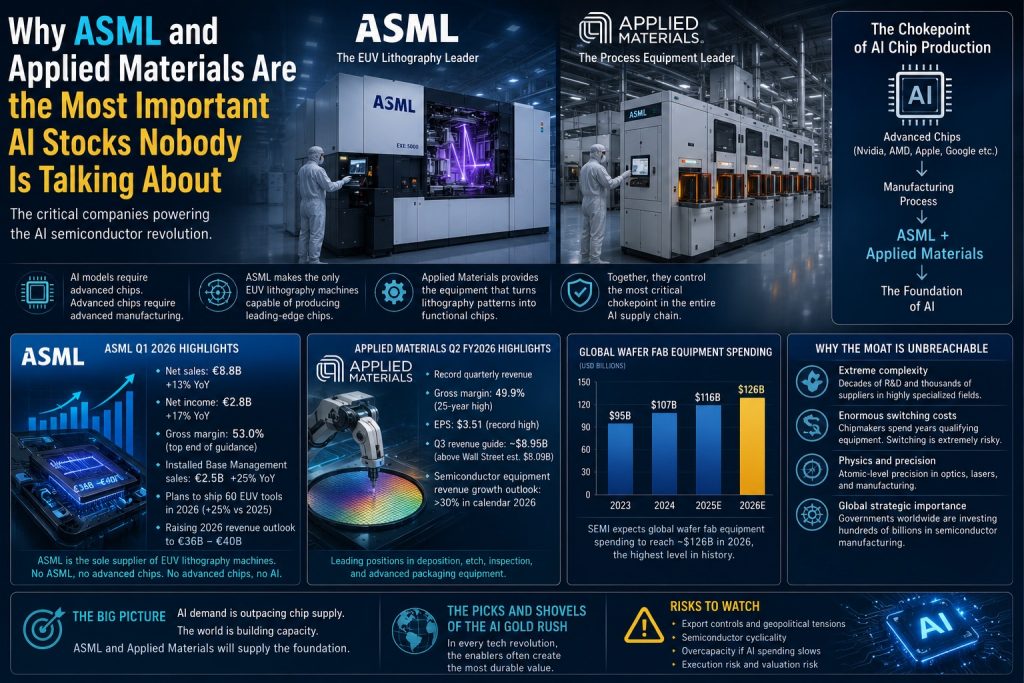
Why ASML and Applied Materials Are the Most Important AI Stocks Nobody Is Talking About
Last Updated: April 2026 | Category: AI Investment Trends
Introduction
Everyone knows Nvidia.
The $3 trillion company that makes the GPUs powering every major AI model. The stock that became the defining investment of the AI era. The company whose name appears in every conversation about AI infrastructure.
But here is what most investors are missing.
Nvidia cannot make a single chip without ASML.
Not one.
ASML — the Dutch company based in Veldhoven, Netherlands — is the sole manufacturer of the extreme ultraviolet lithography machines required to produce advanced semiconductors at the 5nm, 3nm, and 2nm nodes where AI chips are made.
There is no alternative supplier.
There is no workaround.
If ASML stops shipping machines, the global AI chip industry stops producing chips.
Applied Materials — the California-based semiconductor equipment company — is the leading provider of the deposition, etching, and inspection equipment that turns ASML’s lithography patterns into functional chips.
Together, these two companies sit at the most critical chokepoint in the entire AI investment cycle.
Yet they receive only a fraction of the investor attention Nvidia attracts.
The Picks and Shovels Principle Applied to AI
During the California Gold Rush, the merchants selling picks, shovels, and equipment often generated more reliable fortunes than the miners themselves.
That principle repeats throughout technology history.
During the internet boom, networking infrastructure companies benefited from the expansion of online connectivity.
During the smartphone revolution, semiconductor architecture providers quietly became foundational to the mobile ecosystem.
The same pattern is now emerging inside AI.
ASML is not simply a semiconductor company.
It is the only company in the world capable of manufacturing the EUV lithography systems required for advanced AI chips.
Applied Materials occupies a similarly critical position by supplying the process equipment necessary to transform chip designs into functioning hardware.
This is not just a strong competitive moat.
It is a global technological bottleneck.
ASML Controls The Most Important Chokepoint In AI
ASML’s business model is one of the most defensible in modern technology.
The company produces advanced lithography machines required for manufacturing leading-edge semiconductors.
These systems are essential for producing:
- Nvidia GPUs
- Apple processors
- AMD accelerators
- Custom AI chips from hyperscalers
Without ASML’s EUV machines, advanced AI chip production cannot occur.
That gives the company extraordinary strategic importance.
ASML’s Revenue Growth Continues Accelerating
ASML reported exceptionally strong 2026 financial results.
The company raised revenue guidance after stronger-than-expected demand from semiconductor manufacturers expanding AI capacity.
Demand for advanced chips continues exceeding global supply.
That imbalance is forcing chipmakers to accelerate fabrication expansion projects globally.
ASML benefits directly from every new advanced semiconductor facility entering production.
The Installed Base Advantage
One of ASML’s strongest long-term advantages is its installed base management business.
Once semiconductor manufacturers install ASML systems, they continue purchasing:
- Maintenance services
- Performance upgrades
- Optimization software
- Productivity enhancements
This creates recurring high-margin revenue streams extending for years.
As more EUV systems enter operation globally, this recurring revenue compounds automatically.
Applied Materials Powers The Manufacturing Process
While ASML creates the lithography patterns, Applied Materials provides much of the equipment transforming those patterns into functioning chips.
Its tools support critical manufacturing processes including:
- Deposition
- Etching
- Inspection
- Packaging
- Surface processing
These steps collectively determine chip quality, performance, and production yield.
Applied Materials operates across multiple critical stages of semiconductor manufacturing simultaneously.
Record Margins And AI Demand
Applied Materials recently reported record revenue and some of the strongest margins in company history.
AI infrastructure demand is driving growth across:
- Advanced logic manufacturing
- High-bandwidth memory
- Advanced semiconductor packaging
The company expects semiconductor equipment demand to continue expanding aggressively through the second half of the decade.
Why Manufacturing Complexity Matters
Modern semiconductor manufacturing is extraordinarily difficult.
Advanced AI chips require:
- Atomic-level precision
- Extreme process consistency
- Massive capital investment
- Years of equipment qualification
Chipmakers cannot easily switch suppliers.
Changing process equipment involves multi-year testing and significant yield risk.
That creates powerful long-term switching costs benefiting established equipment providers like Applied Materials.
Why Semiconductor Equipment Has Massive Competitive Moats
The semiconductor equipment industry is one of the highest-barrier industries in the world.
Building competitive EUV systems requires decades of research and engineering expertise.
ASML spent over 30 years developing its technological capabilities.
The company’s machines depend on:
- Precision optics
- Laser systems
- Vacuum engineering
- Complex software controls
- Thousands of specialized suppliers
Very few industries possess barriers this extreme.
Applied Materials benefits from similar advantages across process equipment manufacturing.
The technical complexity alone prevents meaningful new competition from emerging quickly.
AI Demand Is Creating A Multi-Year Expansion Cycle
The semiconductor equipment cycle is not short term.
Building advanced fabrication facilities requires:
- Tens of billions of dollars
- Multi-year construction timelines
- Specialized infrastructure
- Government approvals
The fabs under construction today may not become fully operational until 2028 or beyond.
That creates unusually long-duration revenue visibility for semiconductor equipment suppliers.
Governments worldwide are also accelerating domestic semiconductor investment through industrial policy initiatives and subsidies.
This creates a global manufacturing expansion cycle supporting equipment demand for years.
Export Control Risks Remain Important
One of the largest risks facing semiconductor equipment companies involves export restrictions.
The United States has increasingly limited advanced semiconductor equipment exports to China.
These restrictions affect both ASML and Applied Materials.
However, several factors partially offset this risk:
- Semiconductor investment outside China continues accelerating
- Taiwan, South Korea, Japan, Europe, and the United States are expanding aggressively
- AI chip demand remains extremely strong globally
The result is that demand from non-China markets continues compensating for many export-related headwinds.
Why Investors Still Underestimate These Companies
Most retail investors focus heavily on visible AI companies.
Chatbots receive attention.
Consumer AI products dominate headlines.
But the deeper infrastructure layer often receives less discussion.
ASML and Applied Materials operate underneath the AI ecosystem itself.
Every major AI company depends on semiconductor manufacturing capacity.
And semiconductor manufacturing capacity depends heavily on these two firms.
That creates a much more durable long-term investment position than many investors realize.
Conclusion
The AI investment cycle ultimately depends on one foundational reality:
Advanced chips must be manufactured before AI systems can exist.
ASML controls the most critical lithography technology in the world.
Applied Materials controls major portions of the manufacturing process transforming those lithography designs into working chips.
Together, they occupy one of the strongest infrastructure positions anywhere inside the AI economy.
While most investors focus on software platforms and GPU designers, the semiconductor equipment companies quietly enabling the entire AI ecosystem may become some of the most important long-term beneficiaries of the AI era itself.
Because in the end, AI cannot scale without manufacturing capacity.
And manufacturing capacity cannot scale without ASML and Applied Materials.
Tags
ASML stock, Applied Materials stock, AI semiconductor stocks, semiconductor equipment investing, EUV lithography, AI infrastructure stocks, semiconductor manufacturing, AI chip demand, CHIPS Act investing, AI investment trends