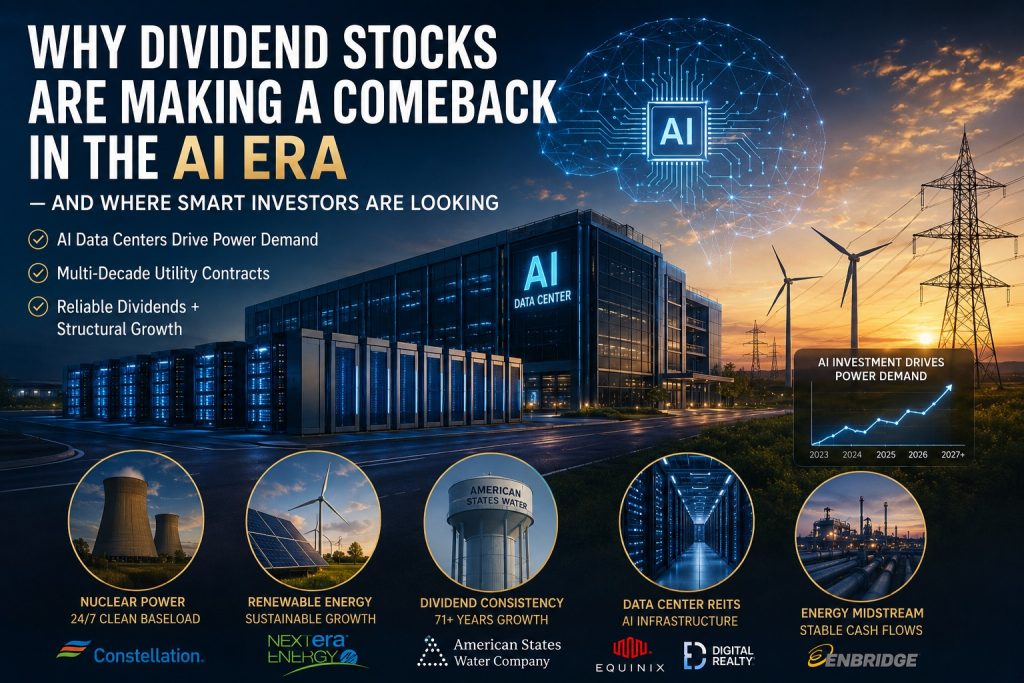
Why Dividend Stocks Are Making a Comeback in the AI Era — And Where Smart Investors Are Looking
Last Updated: April 2026 | Category: AI Investment Trends
Introduction
For most of the past three years, dividend stocks were the trade nobody wanted.
Why own a utility paying a 3% yield when Nvidia was returning 200%? Why hold a regulated electric company with predictable but modest earnings when AI infrastructure stocks were compounding at rates that made income investing feel obsolete?
That calculus is changing in 2026.
Not because AI growth is slowing. It isn’t.
But because AI growth is creating something that dividend investors have not seen in a generation: structural demand acceleration inside the sectors that have always paid the most reliable dividends.
Historically viewed as slow-growth, income-focused investments, utilities are now benefiting from AI-driven infrastructure demands. Data center growth is boosting electricity consumption, supporting higher earnings forecasts and justifying elevated valuations for companies like Constellation Energy and NextEra Energy.
The sector that spent decades growing at 2% per year is now signing multi-decade power purchase agreements with the five largest technology companies in the world.
And it is still paying dividends.
The Transformation Nobody Expected
Utility stocks were supposed to be boring.
Regulated businesses. Slow earnings growth. Predictable dividends. The investment category for retirees who wanted income without volatility.
Then AI happened.
A single hyperscale AI data center now requires between 100 and 300 megawatts of continuous power — roughly the equivalent of 75,000 to 225,000 average American homes, drawn by a single facility around the clock.
The five largest U.S. tech companies have committed between $660 billion and $690 billion in capital expenditure in 2026 alone. A substantial portion of that capital eventually becomes electricity demand — and electricity demand flows directly to utilities.
Entergy plans to invest $41 billion between 2026 and 2029 on new power generation capacity and related infrastructure. The company expects to deliver more than 8% compound annual earnings-per-share growth through 2029 — a growth rate that would be exceptional for any sector, let alone utilities.
Its dividend yield stands at 2.8%.
Eight percent compound EPS growth. From a utility. Driven entirely by AI data center power demand.
This is the story most investors focused on AI software and semiconductors have missed.
📷 이미지 위치 1
AI-powered futuristic power grid connected to massive data centers at sunset
The Power Purchase Agreement Revolution
The mechanism connecting AI investment to utility dividends is the long-term power purchase agreement — and the scale of these deals is genuinely unprecedented.
Constellation Energy signed long-term power purchase agreements with Meta Platforms and Microsoft — including the entire output of Constellation’s 1,121-megawatt Clinton Clean Energy Center nuclear plant to power a Meta data center.
Vistra’s high-profile PPAs include deals with Amazon and Microsoft for solar facilities and a 20-year PPA for its Comanche Peak Nuclear Power Plant with an unspecified hyperscaler.
NextEra Energy agreed to a 25-year deal with Alphabet to acquire 3 gigawatts of energy from a redeveloped nuclear facility.
Talen Energy agreed to supply electricity and its 960-megawatt data center campus to Amazon Web Services in Pennsylvania.
These are not short-term contracts. They are multi-decade commitments — 20 to 25-year agreements that lock in demand visibility at a level utilities have never previously experienced.
For dividend investors, the implication is direct. The earnings base supporting utility dividends is being reinforced by contractual revenue stretching into the 2040s and 2050s.
The uncertainty that has always characterized utility earnings — dependent on weather, regulatory decisions, and commodity prices — is being partially replaced by contracted demand from counterparties with the strongest balance sheets in corporate history.
Constellation Energy finalized its $16.4 billion Calpine acquisition in March 2026 — creating what analysts describe as a “Clean Energy Titan” capable of meeting the power needs of the AI revolution.
The deal is expected to add more than $2 billion in annual free cash flow, supporting a double-digit dividend growth target.
Constellation’s shares surged nearly 20% since the deal’s inception.
The Three Utility Categories Worth Understanding
Not all utilities are equally positioned to benefit from AI power demand.
The investment framework requires distinguishing between three distinct categories.
Category 1: Nuclear-powered utilities with direct tech partnerships
Constellation Energy stands out with its large U.S. nuclear fleet, offering scalable clean energy well-suited for tech sector needs.
The company is projecting annualized earnings growth of around 20% — a rate more consistent with a growth stock than a traditional utility.
Nuclear power’s specific appeal to AI data centers is straightforward:
It provides 24/7 carbon-free generation at scale.
Solar and wind provide intermittent generation — valuable for renewable commitments, but insufficient as the sole power source for facilities that cannot tolerate outages.
Nuclear provides the baseload power AI data centers need most.
Category 2: Large renewable developers with AI partnerships
NextEra Energy operates the country’s largest electric utility, Florida Power & Light, distributing electricity to 12 million people across Florida.
The state has a sales tax exemption for data centers over 100 megawatts, positioning the utility to capitalize directly on AI infrastructure expansion.
NextEra has partnered with Google and others to support growing data center power demand while developing gigawatts of renewable energy and storage capacity.
Category 3: Dividend consistency plays for income-focused investors
American States Water has the longest dividend growth streak among U.S.-listed stocks — more than 71 consecutive annual increases.
The company targets 7% annualized dividend growth going forward, with a current yield of approximately 2.5%.
While less directly exposed to AI demand than electric utilities, it offers the income stability many investors combine with higher-growth utility positions.
📷 이미지 위치 2
Modern nuclear plant and AI data center illuminated at night
Beyond Utilities: Dividend Payers With AI Exposure
The AI-dividend intersection extends beyond electric utilities.
Oracle presents an unusual case: a technology company that pays a dividend while committing aggressively to AI infrastructure.
The company’s annual revenue is expected to grow dramatically through 2030, driven primarily by AI cloud infrastructure expansion.
Qualcomm also benefits from the rise of edge AI through Snapdragon processors optimized for on-device inference across smartphones and laptops.
Enterprise Products Partners operates energy infrastructure with stable fee-based revenues, offering yields above 5%.
As AI data centers increasingly rely on natural gas bridge power while grid infrastructure expands, midstream energy companies benefit indirectly from AI electricity demand.
The Infrastructure REITs: Data Center Dividends
The most direct combination of AI exposure and dividend income is the data center REIT sector.
Data center REITs own the physical facilities housing AI compute and are required to distribute at least 90% of taxable income to shareholders as dividends.
Equinix, Digital Realty, and Iron Mountain are among the largest publicly traded data center REITs.
Their dividend yields are modest compared to traditional utilities — typically between 1.5% and 3% — but their long-term growth potential is directly tied to AI infrastructure demand.
When hyperscalers sign 10 to 20-year leases for AI data center capacity, they create highly predictable income streams supporting future dividend payments.
Why High-Yield Is Attracting Attention Again
Beyond AI-specific opportunities, high-yield income investments are attracting renewed institutional interest in 2026.
Ares Capital provides high-interest loans to smaller companies while delivering dividend yields above 10%.
At the same time, elevated interest rates have made investors increasingly selective about where they allocate capital.
Dividend stocks offering both income and growth — particularly utilities benefiting from AI demand — are becoming attractive alternatives to traditional fixed income.
The Risk Framework for AI-Era Dividend Investing
The AI-utility thesis is compelling.
But it is not risk-free.
Valuations have already moved significantly higher.
Constellation Energy trades at valuation multiples that would have been unimaginable for utilities before AI demand accelerated.
If hyperscaler AI spending slows, utility growth assumptions may weaken.
Capital expenditure requirements are also enormous.
Utilities must invest billions into generation capacity, transmission infrastructure, and grid modernization to meet future AI demand.
Regulatory approval remains another major variable.
Utilities operate inside highly regulated environments where approved returns depend heavily on state-level decisions.
Grid connection timelines also create execution risk, with many large infrastructure projects extending well into the late 2020s.
Conclusion
The AI era is rewriting the investment case for dividend stocks.
Electric utilities — once considered slow-growth income investments — are becoming critical infrastructure providers for the largest technological expansion cycle in decades.
Multi-decade agreements with hyperscale technology companies are creating earnings visibility unlike anything utilities historically experienced.
Constellation Energy, NextEra Energy, Entergy, and other infrastructure-focused companies are no longer just conservative dividend payers.
They are becoming foundational players in the AI economy itself.
For investors seeking both income and exposure to AI infrastructure growth, 2026 may represent one of the most unusual opportunities in modern market history.
The most surprising part?
The AI revolution may ultimately make dividend investing exciting again.
Tags
Dividend stocks, AI investing, utility stocks, AI infrastructure, Constellation Energy, NextEra Energy, data center REITs, passive income investing, AI power demand, dividend growth stocks