Introduction
Most investors watch the Federal Reserve for one reason.
Stock valuations.
When rates fall, future earnings are worth more today. When rates rise, they are worth less. This is the textbook relationship between monetary policy and equity markets.
But in 2026, there is another dimension that matters just as much.
Borrowing costs for infrastructure.
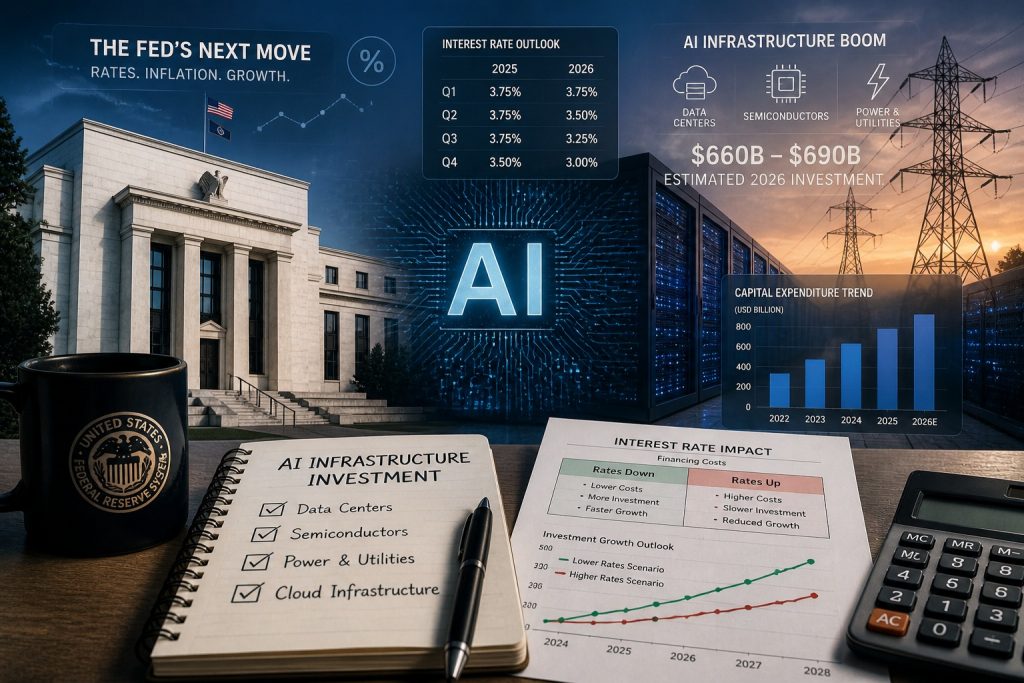
Major technology companies are committing massive capital to AI infrastructure. A significant portion of this spending depends on financing conditions tied directly to interest rates.
When the Fed holds rates steady, financing becomes more expensive.
When the Fed cuts, investment accelerates.
Where the Fed Stands in 2026
The Federal Reserve has maintained a cautious stance.
Rates remain elevated as policymakers balance inflation concerns with economic growth. Internal disagreement within the Fed reflects uncertainty about the path forward.
This creates volatility.
Markets are reacting not just to decisions, but to expectations about future policy moves.
Why Rates Matter for AI Investment
AI infrastructure requires significant capital.
Data centers, semiconductors, and energy systems involve long-term investments. These are often financed through debt markets.
Higher rates increase financing costs.
Lower rates improve the economics of these projects.
This directly affects how quickly AI infrastructure expands.
The Role of Energy and Utilities
AI systems require large amounts of electricity.
This has led to major investments in power infrastructure. Utilities are increasing capital spending to meet growing demand.
Financing costs play a critical role.
Higher borrowing costs can slow expansion or increase electricity prices.
Lower costs support faster development and lower long-term expenses.
Market Valuation Impact
Interest rates also affect equity valuations.
Higher rates reduce the present value of future earnings. This impacts high-growth sectors like AI more significantly.
Lower rates provide support.
They increase valuation multiples and improve investor sentiment.
The Inflation Challenge
The Fed cannot act freely.
Inflation remains above target, limiting the ability to cut rates aggressively. Energy prices and global factors continue to influence inflation trends.
This creates a balancing act.
Supporting growth while controlling inflation is not simple.
What Investors Should Watch
Investors should focus on key indicators.
Long-term interest rates, bond market conditions, and corporate financing trends provide insight into future AI investment activity.
Monitoring these factors helps identify changes in momentum.
It also provides context for market movements.
Conclusion
The Federal Reserve plays a central role in shaping the investment environment.
In 2026, its decisions directly influence the cost and pace of AI infrastructure development.
Rate cuts can accelerate growth.
Rate stability can slow expansion.
But the long-term trend remains intact.
AI investment continues because of structural demand, not just monetary policy.
This article is for informational purposes only and does not constitute financial or investment advice. Always consult a qualified financial professional before making investment decisions.