Introduction
AI is not slowing down in 2026.
If anything, the pace is accelerating — but not in the way most investors think.
While headlines focus on new models and applications, the real story is unfolding underneath.
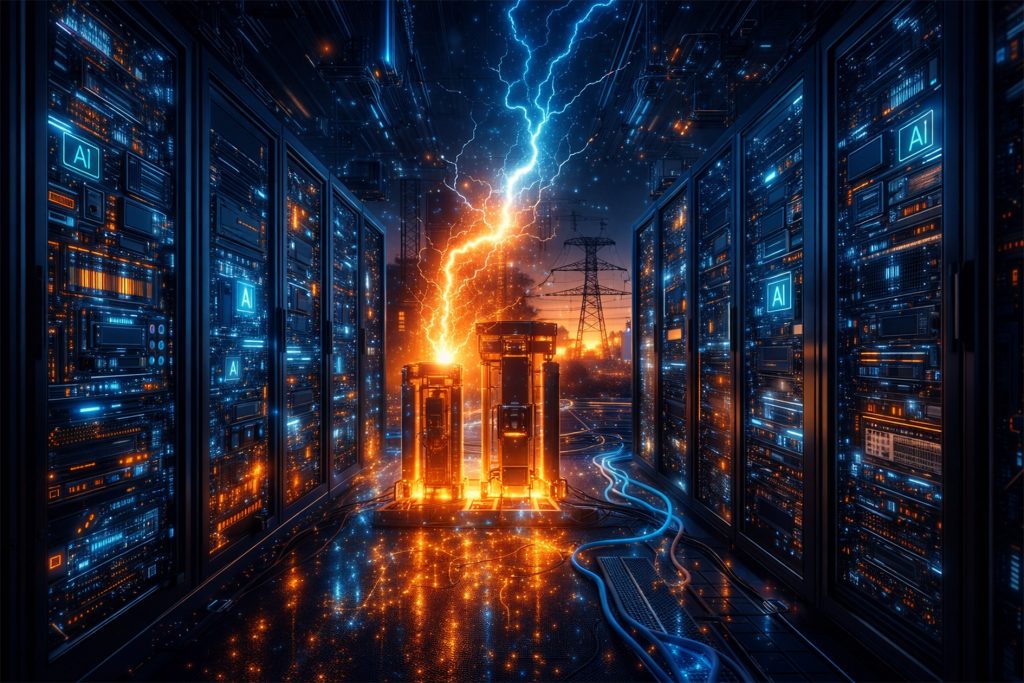
The physical infrastructure required to run AI is reaching its limits.
Not in chips. Not in capital.
In power.
And that changes everything.
The Shift No One Expected
For the first two years of the AI boom, the primary constraint was hardware.
Companies couldn’t get enough GPUs. Supply chains were stretched. NVIDIA’s Blackwell allocation was oversubscribed before it shipped. TSMC couldn’t manufacture advanced processors fast enough.
That constraint has now shifted.
The bottleneck is no longer silicon.
It is electricity.
A single AI task can require up to 1,000 times more electricity than a traditional Google search. A single hyperscale AI data center now draws between 100 to 300 megawatts of continuous power — roughly the equivalent of 75,000 to 225,000 average American homes. A single facility. Around the clock. Every day.
And the grid was built for a different era entirely.
Why Power Is Now the Bottleneck
The numbers tell the story.
The IEA projects global data center electricity consumption will reach nearly 945 TWh annually by 2030 — growing at approximately 15% per year. That is more than four times faster than electricity consumption growth across every other sector combined.
Morgan Stanley Research forecasts U.S. data center demand reaching 74 GW by 2028 — against a projected shortfall of approximately 49 GW in available power access.
Goldman Sachs projects AI data center electricity demand will grow 160% by 2030.
Meanwhile: of approximately 140 large-scale U.S. data center projects representing 12 gigawatts of power planned to go live in 2026, only one third are under construction. The rest are stalled — not from lack of capital or demand, but because the electrical grid cannot support them.
Sightline Climate reports that 50% of global data center projects are facing delays due to power limitations and grid equipment shortages.
Gartner predicts power shortages will restrict 40% of AI data centers by 2027.
The bottleneck is not demand. It is not capital.
It is transformers, switchgear, and grid connections — components with lead times stretching five years in a sector where deployment cycles run under 18 months.
The Real Constraint: Infrastructure Lag
Hardware supply chains can scale in 12 to 24 months.
Power grids cannot.
In major data center markets right now:
Grid connection approvals in Northern Virginia and Dublin stretch to 2028 or beyond. High-voltage transformers already have 18 to 24 month lead times — and demand is still rising. Communities near major data center clusters in Virginia, Texas, and Georgia are seeing electricity rate increases of 8% to 15% from concentrated demand. In West London, power allocated to a new data center cluster has delayed housing and commercial development by up to ten years.
Microsoft has an estimated $80 billion unfulfilled Azure backlog constrained not by customer demand — but by available electricity. The company has reportedly acknowledged turning away customers due to power shortages.
This is not a temporary disruption.
It is a structural mismatch between the fastest-moving capital allocation cycle in technology history and infrastructure that was built for a different world.
Why This Is Bullish — Not Bearish
Most investors misread supply constraints as negative signals.
In infrastructure markets, the opposite is often true.
When demand exceeds supply and the constraint is physical rather than financial:
Pricing power increases. Companies with available power capacity can charge more. Margins expand. Revenue visibility improves — because customers are already waiting, not still deciding. Long-term contracts get signed earlier, at better terms, to secure scarce capacity.
AI infrastructure companies are not struggling to find customers.
They are struggling to keep up with customers who are already there.
CoreWeave — which went public in March 2025 — is guiding $12 to $13 billion in revenue for 2026, roughly 140% growth, against a contracted backlog exceeding $66 billion. That backlog is signed, committed demand for capacity that has not yet been built. The constraint is power access, not customers.
This is a rare and favorable market condition.
The Capital Commitment Is Locked In
The five largest U.S. tech companies — Microsoft, Amazon, Alphabet, Meta, and Oracle — are collectively committing between $660 billion and $690 billion in capital expenditure in 2026 alone. Nearly doubling their 2025 spending.
This is not speculative. It is contracted, funded, and already being deployed.
Amazon is projecting approximately $200 billion in capital expenditure this year. Microsoft is tracking toward $120 billion. Alphabet has guided $175 to $185 billion.
These companies cannot pause without disrupting their own platforms. Their AI services run on infrastructure they are still building. The capital is committed in the same way that a highway project is committed once the concrete is poured.
And crucially — Goldman Sachs Research notes that consensus AI capex estimates have proven too low for two consecutive years. Analysts predicted 20% growth at the start of both 2024 and 2025. The actual result exceeded 50% in both years.
How Hyperscalers Are Solving the Power Problem
When the grid cannot keep up, the world’s largest technology companies do something that would have seemed implausible five years ago.
They build their own power generation.
Natural gas is the immediate bridge. Meta’s Hyperion project in Louisiana includes a 2 gigawatt combined-cycle gas plant built directly alongside its data center — bypassing the public grid entirely.
Nuclear is the long-term bet. The scale and reliability of nuclear power — 24/7 carbon-free generation — makes it uniquely attractive for AI data centers that cannot tolerate interruption.
The deals already signed are historic:
- Microsoft committed to a 20-year, 835-megawatt agreement to restart Three Mile Island
- Meta secured deals with Vistra, Oklo, and TerraPower for up to 6.6 gigawatts of clean energy by 2035
- Amazon backed 5 gigawatts of small modular reactor projects and invested over $20 billion in a nuclear-powered data center campus
- Google contracted for up to 500 megawatts of SMRs from Kairos Power
- Oracle announced a gigawatt-scale data center powered by three small modular reactors
Big tech companies collectively signed contracts for more than 10 gigawatts of possible new nuclear capacity in the United States in the last year alone.
The global pipeline of small modular reactor projects reached 47 gigawatts at the end of Q1 2026 — with more than half in the U.S.
Nuclear energy transformed from a declining industry into the centerpiece of AI infrastructure strategy. Not because of climate policy. Because of math.
The Second-Order Winners
As the bottleneck shifts from chips to power, the winners shift as well.
Beyond semiconductors, capital is flowing into sectors most AI investors have historically underweighted:
Electrical equipment manufacturers sit at the most acute constraint. High-voltage transformers and switchgear now have lead times stretching 18 to 24 months. The companies manufacturing this equipment have pricing power that is rarely seen in industrial markets — because customers cannot substitute or wait.
Cooling systems are becoming mandatory infrastructure, not optional upgrades. Less than 10% of data centers are liquid-cooled today. Every new GPU generation makes liquid cooling a physical requirement. Vertiv reported a 252% increase in orders as rack densities surpassed 100 kilowatts. Madison Air Solutions — which raised $2.23 billion in the largest U.S. industrial IPO since 1999 on April 15 — saw its shares jump 18% on its first day, specifically because investors recognized its data center infrastructure tailwind.
Power utilities and grid modernization are experiencing a secular demand shift after two decades of flat electricity growth. Global infrastructure companies are forecast to deliver 15.9% earnings growth in 2026 — dwarfing historical averages — driven specifically by AI data center demand.
Data center real estate. Companies with existing sites that have secured power access are sitting on assets of extraordinary strategic value. The scarcity of land with available grid connection is creating pricing power for existing operators that new entrants cannot replicate quickly.
These sectors do not depend on which AI model wins.
They depend on whether AI continues to grow.
And right now, everything says it will.
The Compounding Demand Cycle
AI demand is not linear.
Each new adoption layer adds to total infrastructure demand — and none of them substitute for prior demand.
Financial services: JPMorgan Chase reported Q1 2026 net income of $16.5 billion, with AI-enhanced trading infrastructure playing a direct role. Morgan Stanley posted record revenues of $20.6 billion in the same quarter.
Healthcare: AI drug discovery investment is projected to reach $2.51 billion in 2026 and $16.49 billion by 2034. OpenAI’s GPT-Rosalind, launched this week with Amgen, Moderna, and Thermo Fisher Scientific as partners, is the most visible current example.
Manufacturing: Hyundai Motor Group committed $26 billion in U.S. investment through 2028 for AI robotics. PepsiCo’s AI digital twin partnership with NVIDIA and Siemens is generating 20% improvement in throughput and 10-15% reduction in capital expenditure.
Enterprise software: SAP’s AI deployment handles over 40% of enterprise contact center queries and cut commercial email processing time by 70%.
Each of these does not replace prior demand.
It stacks on top of it.
The AI infrastructure market is projected to grow from $158 billion in 2025 to $418 billion by 2030 — a 21.5% compound annual growth rate — driven by compounding adoption across multiple industries simultaneously.
The Risk Investors Should Understand
The biggest risk is not demand.
It is timing.
Even with confirmed demand and committed capital, power delays create specific financial risks that matter for position sizing:
Revenue recognition can shift. A data center that is fully funded and contracted but waiting for grid interconnection until 2028 does not generate revenue until it opens. Companies with large announced-but-not-yet-operational pipelines carry timing risk that is underappreciated by investors focused on backlog size rather than delivery schedule.
Execution risk is real. Deloitte estimates U.S. AI data center power demand could grow more than 30 times by 2035. But the path from current capacity to that future demand runs through regulatory approvals, equipment manufacturing timelines, and construction cycles that have never been stress-tested at this scale simultaneously.
Cost inflation is compounding. Electricians and specialized data center construction technicians are in short supply. Materials costs are rising. The Iran conflict’s energy price shock — which pushed oil above $100 per barrel and jet fuel refining margins to $120 per barrel — has raised energy infrastructure costs across the board.
Demand is strong. Capital is committed. But execution still matters.
Conclusion
AI infrastructure is not slowing down.
It is hitting a physical constraint — and adapting around it.
The bottleneck moved from silicon to electricity. The hyperscalers are responding by building their own power generation — natural gas plants, nuclear power purchase agreements, small modular reactor contracts — at a scale unprecedented in the history of corporate energy procurement.
The capital is still flowing. $660 to $690 billion committed for 2026 alone. The demand is still compounding across every major sector of the global economy. And the companies positioned at the constraint — electrical equipment, cooling systems, power infrastructure, data center real estate with secured power access — are experiencing pricing power and revenue visibility that most technology investments cannot match.
Most investors are watching AI at the surface level.
The real story is happening underneath — where electricity, not software, determines how fast the future arrives.
And the power bottleneck is not ending in 2026.
It is just beginning.
This article is for informational purposes only and does not constitute financial or investment advice. Always consult a qualified financial professional before making investment decisions.